


Key Takeaways
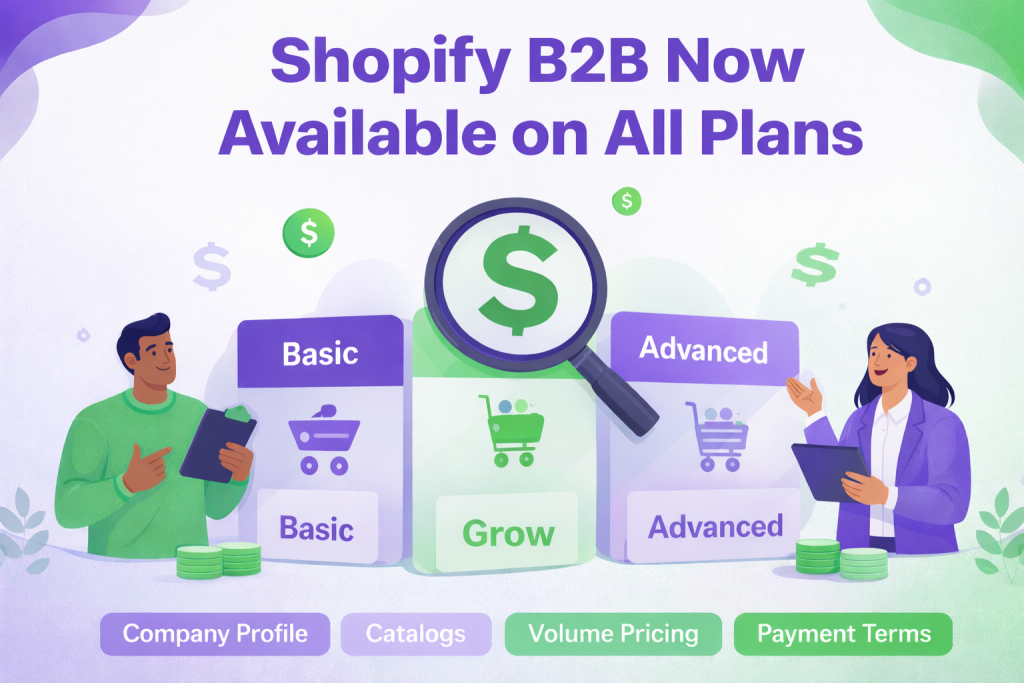
- Shopify B2B on all plans is available effectively from April 2, 2026. All paid plans get company profiles, catalogues, volume pricing, and payment terms.
- The 3-catalog limit is the first ceiling most merchants hit. It applies across all markets combined, not per market. Unlimited catalogs remain on Plus only.
- For simple wholesale setups with a few accounts and straightforward pricing, the native features are genuinely enough.
- Advanced workflows like cart discounts, registration forms, per-tier shipping, content locking, and POS pricing are not part of the native stack at any plan below Plus.
- Several features including discount codes and abandoned checkout emails are off by default and need Shopify Support to activate. In a blended store, enabling them turns them on for all customers, not just wholesale buyers.
- Third-party app compatibility is not guaranteed. Shopify’s B2B App Guide currently lists 11 confirmed compatible apps. Merchants with an existing app stack should check before switching on native B2B.
On April 2nd, Shopify made one of its most significant platform updates in recent years by bringing its core B2B features to every paid plan. For a long time, anyone wanting to run a native wholesale operation on Shopify had to subscribe to Shopify Plus, which starts at $2,300 per month. That price gap acted as a massive barrier for small and mid-sized brands.
This move is a win for the merchant community because it legitimizes wholesale as a core part of the Shopify ecosystem. However, as with any major update, it is important to look past the headlines. While the barrier to entry is gone, the native features come with specific limits that determine how far you can scale before needing a more robust solution.
Shopify B2B on all Plans – Feature Snapshot
Here is what is NOW included on Basic, Grow, and Advanced plans of Shopify at no extra cost:
| Feature | What It Does |
| Company profiles | Create structured accounts for wholesale buyers, with multiple locations per company |
| B2B catalogs (up to 3) | Custom pricing per buyer group, percentage off, fixed prices, or volume breaks. Catalogs are assigned via Shopify Markets. |
| Volume pricing | Up to 10 quantity price breaks per product, fixed price per variant only |
| Quantity rules | Minimum order quantities, maximums, and case pack increments per SKU |
| Payment terms | Net 7, 15, 30, 45, 60, 90 and due on fulfillment |
| PO numbers | Supported on all B2B orders |
| Reorder from account | Buyers reorder from past orders in their account |
| CSV import and export | Upload and manage catalog pricing in bulk |
| Contextual product publishing | Hide products from retail, visible only to B2B catalog holders |
| Shopify Flow with B2B objects | Automation around company events, orders, and more |
For merchants just getting started with wholesale, this removes the initial friction of setting up the basics. That said, several third-party Shopify wholesale apps have long covered what previously required a Shopify Plus subscription and still go well beyond what the native stack offers today.
The Limitations Worth Knowing About
The three-catalog limit is where most growing merchants hit a wall. That cap applies across all B2B markets combined, not per market. So if a US Wholesale market uses three catalogs for Bronze, Silver, and Gold pricing, there is nothing left for a UK market or a Distributor tier. The only way past it natively is Shopify Plus at $2,300 per month.
Beyond the catalog cap, several things are turned off by default and easy to miss:
| Default-Off Feature | What You Need to Do |
| Discount Features for B2B | To implement bulk discount and pricing on your B2B catalog, you need to first contact Shopify support team to enable them |
| Abandoned checkout emails | Must be manually activated for B2B |
| Manual payment methods | Requires a separate request to Shopify |
There is also a checkout compatibility issue that catches merchants off-guard. When Shopify B2B is active, Shop Pay, Apple Pay, Google Pay, and Amazon Pay all stop working. They do not degrade or become optional, but they go away entirely for the B2B checkout flow. For stores where those accelerated options are a meaningful part of conversion, this is a real trade-off.
A few other gaps that matter in practice:
- No self-service registration form. Shopify Forms (a separate free app) lets buyers request access, but it does not auto-tag, auto-approve, or create company profiles. Every application still needs manual work in admin.
- No POS compatibility. B2B pricing does not carry through to Shopify POS. Trade show orders, showroom sales, and any in-person wholesale transaction falls outside the native B2B stack entirely.
- Classic customer accounts do not work. B2B requires the new company account system. Merchants with an established customer base need to factor in that migration.
Who Native B2B Is Genuinely Enough For
If you have two or three wholesale accounts, one pricing tier per group, and no POS or Shop Pay dependency, Shopify native B2B covers you well. Company profiles, payment terms, volume pricing, and CSV-based catalog management handle a straightforward wholesale setup without any additional cost.
Where the Native Stack Runs Short
The gaps become real problems at a fairly predictable point in a wholesale operation’s growth. Below are the most common scenarios.
- More than 3 pricing tiers
A distributor running Gold, Silver, Bronze, Distributor, and Retail pricing needs five separate configurations. Three catalogs cover three of them. The native path from there is Shopify Plus at $2,300 per month. Wholesale Pricing Discount B2B handles unlimited discount groups via customer tags on any Shopify plan, from $24.99 per month. - Catalog assignment without Plus
On non-Plus plans, catalogs are assigned through Shopify Markets, not directly to a company or location. So if you need Customer A and Customer B in the same market to see different prices, you cannot do that natively below Plus. - Per-customer variant pricing
Shopify catalogs support fixed prices per variant, but the pricing is per-catalog, not per-customer. With three catalogs, you get three price lists, and everyone in a catalog sees the same prices. - CSV import at scale
Shopify’s catalog CSV works per catalog, one at a time. If you have ten customer segments with different pricing, you are managing ten separate catalog files. - Cart-level discounts
Shopify’s volume pricing works at the product level i.e buy more of this specific item and the unit price drops. What it cannot do is look at the cart as a whole. So common wholesale incentives like “spend $1,000 and get 10% off your order” or “buy any 50 items across your cart for an extra 5%” have no native mechanism in Shopify B2B. - Wholesale registration and onboarding
Shopify does not include a self-service registration flow. There is a separate free app called Shopify Forms that lets buyers request access, but you don’t get auto-tagging, approval workflow, and automated onboarding. Every application still lands in your admin as a manual task. - POS wholesale pricing
POS Wholesale Pricing matters for anyone selling at trade shows, showrooms, or any physical location where wholesale pricing needs to be consistent with the online store. The native B2B doesn’t contain this feature. - Discount codes by customer segment
Shopify native discount codes, once activated, apply across B2B and DTC customers by default. Restricting them to specific wholesale tiers requires additional setup. - Advanced Shipping Rules
Shopify’s shipping rates are not B2B-aware. You can set flat rates or weight-based rates, but there is no way to give your Gold-tier wholesale buyers free shipping while Silver-tier pays a flat fee, or to automatically drop the shipping cost once a wholesale order crosses $500. Those structures are standard in wholesale and simply do not exist in the native B2B stack.
The Cost Comparison
| Setup | Monthly Cost | What You Get |
| Shopify Basic only (native B2B) | $39/mo | 3 catalogs, company profiles, volume pricing, net terms, quick reordering. No locking, no order forms, no native registration, no POS, no Shop Pay. |
| Shopify + Wholesale Helper Apps | ~$84/mo | Everything above, plus unlimited pricing tiers, self-service registration with auto-approval, cart minimum enforcement, cart-total and cart-quantity discounts, collection-level discounts, per-tier shipping rates, wholesale discount codes, content locking by customer tag, full catalog order form, automated net terms reminders with PDF invoices, Shopify POS integration, and Shop Pay and Apple Pay compatibility. |
| Shopify Plus | $2,300/mo | All native features, unlimited catalogs, deposits, EDI. Still no content locking, no order forms, no registration form, no payment reminders. |
What This Means Going Forward
The new B2B features on Shopify are an excellent starting point. If you have a simple wholesale setup with one or two tiers and you don’t mind the manual work of setting up new accounts, the native tools are likely all you need. It is a powerful way to test a wholesale channel without any extra cost.
As you scale, you will very likely hit a point where the native tools feel restrictive. This usually happens when you need your fourth pricing tier, when you are tired of manually approving every new account, or when you need your wholesale prices to work at a trade show.
The jump from a standard Shopify plan to Shopify Plus is a 58x increase in price. For most merchants, that is not a practical move just to get a few extra features. The best strategy is to use Shopify for what it does best, providing a secure, reliable foundation for your store, and then layer on specialized tools to handle the unique complexities of your wholesale business. The barrier to entry is gone, and now you have the flexibility to build a wholesale channel that fits your specific needs.
When native B2B is not enough, Wholesale Pricing Discount is the next step.
Try our Wholesale Pricing Discount app for free !
Trusted by over 15,000 Shopify merchants