


![How To Set Wholesale pricing for Health & Wellness Brand [2025]](https://wholesalehelper.io/blog/wp-content/uploads/2025/08/How-To-Set-Wholesale-pricing-for-Health-Wellness-Brand-2025--1024x576.png)
Starting a health and wellness brand can teach you an important lesson, such as that setting wholesale prices for health products is not as simple as adding a 50% markup to your costs. Many founders lose their planned margins when they account for the real expenses of compliance testing, the difficulties of handling expiry dates, and the expectation that health store owners want brands to actively support their product launches.
Successful supplement founders, pharmacy buyers, and natural health store owners have discovered a specific approach to the wholesale market. When executed well, wholesale can become a brand’s most profitable sales channel. This guide offers a clear understanding of setting up wholesale pricing for health & wellness brand.
Find Your Perfect Wholesale Price in Seconds
Calculate My Wholesale Price for FREE
Instantly calculate the right price to maximize profit and keep your customers happy.
Why Health and Wellness Wholesale Pricing Is Different?
Walk into any major health store, and you’ll see shelves packed with supplements. What you don’t see is the invisible infrastructure that makes it possible: the lab testing that can cost thousands of dollars, the regulatory paperwork that is intensely detailed, and the fact that one bad batch can torpedo an entire business.
Founders have sat in meetings with major retail buyers who rejected products because the Certificate of Analysis wasn’t formatted exactly as requested. Brands have lost tens of thousands of dollars’ worth of inventory because they couldn’t prove proper cold-chain handling during shipping. This isn’t typical e-commerce—this is a regulated industry where a pricing strategy needs to account for complexities that most sellers never dream about.
The Hidden Costs That Destroy Profit Margins
Here’s what experienced founders will tell you about supplement manufacturing costs:
- Quality Testing is a Major Expense: Every batch needs third-party verification, which can cost hundreds of dollars per batch for comprehensive testing. When a brand is producing 5,000 units, that’s a significant per-unit cost that must be factored in. Miss this in your calculations, and the brand is already at a disadvantage.
- Compliance Documentation Is a Full-Time Job: A brand’s first year is often spent creating more regulatory documents than actually selling products. Certificate of Analysis templates, label compliance reviews, ingredient safety assessments—it adds up fast. It’s crucial to budget for regulatory overhead, or the brand will get surprised.
- Expiry Dates Create Inventory Nightmares: Unlike selling t-shirts, these products have expiration dates. A brand can learn this lesson when a major retailer returns thousands of dollars worth of products that were approaching their expiry date because the retailer’s policy required a longer minimum shelf life upon receipt. Experienced brands now build dating allowances into every wholesale agreement.
The Channel Reality Check: What Different Retailers Want
After years of wholesale relationships, founders have learned what different retail channels expect:
- Independent Health Food Stores: These owners are passionate but often have tight cash flow. They want 45-50% margins, but they also value payment terms (Net 30 is standard), free samples for staff, and educational materials that help them sell the products.
- Pharmacy Chains: They are conservative, risk-averse, and bureaucratic. They want established brands with clean regulatory records. Margins are often tighter (40-45%), but volumes are higher. A chain like CVS might require a 99.5% fill rate—miss that, and the brand is out.
- Fitness Centers and Wellness Spas: These venues typically offer higher margins (50-60%) but smaller volumes. They are selling a lifestyle and performance, not just nutrition. A gym owner might prefer to carry 5 premium products that their trainers believe in rather than 20 products that just sit on shelves.
Online Retailers (Including Amazon): These buyers are price-focused and margin-sensitive. They want competitive wholesale prices (a 35-40% margin is common), but they also want MAP protection so they aren’t competing with other sellers on price. An Amazon buyer might be focused on velocity and profit per square inch over a brand’s story.
Getting Your Numbers Right
Here’s a real example from a product line—a premium omega-3 that retails for $39.99.
The Real Landed Cost Breakdown:
- Fish oil concentrate and softgel manufacturing: $4.20
- Packaging (bottle, label, tamper seal, box): $1.15
- Third-party testing amortized across batch: $0.35
- Regulatory compliance and documentation: $0.20
- Temperature-controlled inbound freight: $0.65
- 3PL receiving and specialized storage: $0.55
- Payment processing and operational buffer: $0.40
- Total landed cost: $7.50
Working Backwards from Retail:
- Target retail price: $39.99
- A retailer needing a 45% margin would require a $21.99 wholesale price.
- The brand’s gross margin: $21.99 – $7.50 = $14.49 (66% gross margin)
This looks great on paper, but that $14.49 needs to cover customer acquisition, marketing, sales team salaries, returns and allowances, bad debt, and operational costs. After all of that, a brand is looking at a much lower net margin.
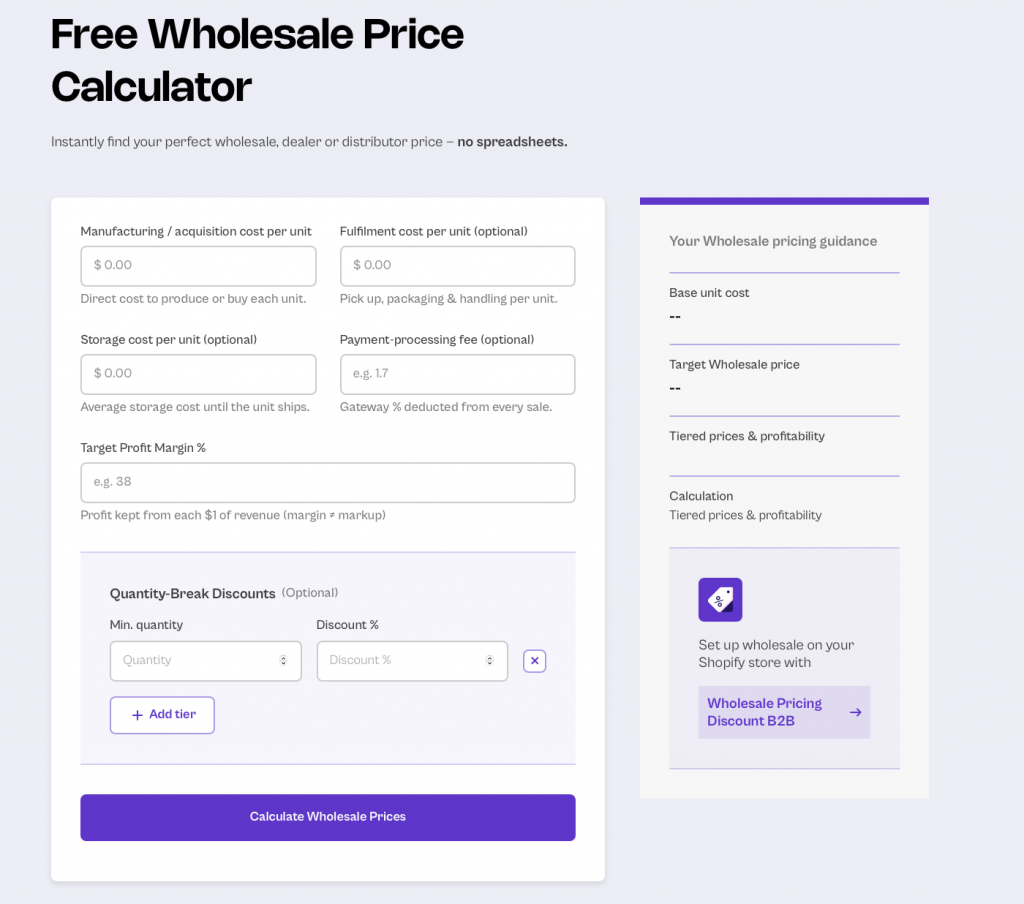
You can use this Wholesale Price Calculator to determine your optimal wholesale price.

Managing International Pricing
Expanding internationally can destroy a brand’s margins until regional cost variations are accounted for.
- Canada might seem easy, but it requires Health Canada product licensing, bilingual labeling, and different testing requirements that all add to the per-unit cost.
- The EU is even more complex, with potential novel food assessments, country-specific notification fees, varying VAT calculations, and strict health claims restrictions that require label redesigns.
The solution is to create separate P&Ls for each major market and price accordingly. An omega-3 that wholesales for $21.99 in the US might sell for €22.50 in Germany and $28.50 in Canada.
Setting Up Your Shopify Wholesale System
This is where many supplement brands get stuck: Shopify’s standard plan doesn’t handle the complexity of B2B health product sales out of the box.
- The Scaled Solution: Shopify Plus: Brands typically upgrade to Plus when their wholesale revenue hits a significant level. The native B2B features are worth it for managing multiple customer price lists, complex payment terms, regional pricing, and volume-based tiers. While the monthly cost is substantial, the time savings and reduced errors are worthwhile at scale.
- The Lean Route: Apps for Standard Shopify: Before a brand can justify Plus, a lean operation can be run on standard Shopify wholesale apps.
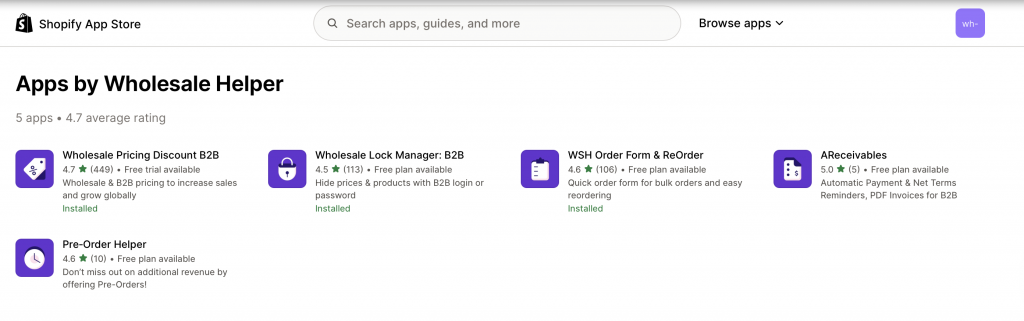
Wholesale Pricing Discount B2B serves as the pricing engine, handling customer-specific pricing and volume discounts. Wholesale Lock Manager B2B keeps retail customers from seeing wholesale prices, and WSH Order Form & ReOrder creates a professional grid-style ordering experience that buyers prefer.

Managing Expiry Dates
This is where supplement wholesale gets tricky. A brand might learn this lesson when a major buyer rejects a large order because the products only had 14 months of shelf life remaining, and the buyer’s policy required 18 months minimum.
A functional expiry date management system includes:
- FEFO (First Expiry, First Out) with a 3PL: A good logistics provider uses warehouse management software that automatically ships older inventory first.
- Sensible Dating Allowances: This can be structured with different discounts based on the remaining shelf life, with full price for products with 12+ months remaining, a small discount for 6-12 months, and a larger discount for 3-6 months.
- Proactive Communication: A brand can send monthly reports to major accounts showing the remaining shelf life on their typical orders. No surprises means fewer returns.
Margins and Profitability
- First-year margins will be tight. A brand should plan for 30-40% gross margins instead of the 60%+ they calculated on paper.
- Geographic expansion costs more than you think. Every new country requires regulatory investment and local partnerships. A brand should not expand to a new market unless it can commit substantial capital to do it right.
- Customer concentration is dangerous. When a single customer represents a large percentage of wholesale revenue, the brand is essentially working for them. It’s wise to cap any single customer at a certain percentage of wholesale sales.
- Payment terms matter more than pricing. A customer paying Net 15 with a 45% margin is often better than one paying Net 60 with a 50% margin. Cash flow kills more supplement companies than low margins.
Ready to impress your B2B customers? Start wholesaling like a pro! 🙂
Try our Wholesale Pricing Discount app for free !
Trusted by over 15,000 Shopify merchants
Frequently Asked Questions On Wholesale Pricing for Health & Wellness Brand
How to price products with premium ingredients?
A brand can multiply its standard margin by 1.2-1.5x for certified organic products and 1.3-1.8x for grass-fed or wild-caught ingredients. The key is to communicate the value story to retailers.
Should a brand offer the same wholesale terms to all customers?
Absolutely not. It’s smart to have different customer tiers: New accounts (Net 15), Established accounts (Net 30), Strategic partners (volume bonuses), and Distributors (deeper discounts, exclusive territory rights).
How to prevent wholesale customers from competing with direct sales?
A brand should implement and religiously enforce a Minimum Advertised Price (MAP) policy.
Should a brand dropship for wholesale customers?
Only for established accounts with a proven sales history. Dropshipping ties up inventory and creates customer service complexity.
How to handle international compliance variations?
It’s often best to partner with regulatory consultants in each major market rather than trying to become an expert in every country’s rules.
What’s the real cost of entering retail chains like CVS or Walgreens?
Beyond the obvious costs, there are hidden expenses like slotting fees, promotional funding requirements, and charge-backs. A brand should budget a substantial amount for major chain entry.
How to scale internationally without breaking cash flow?
The best strategy is to expand one country at a time and partner with local distributors who handle regulatory, logistics, and payment collection.