


Jumping into the world of wholesale for your food or coffee business can be really exciting! However, it’s a whole different ball game compared to selling directly to customers. You’ll find that the profit margins are often slimmer, the regulations can change, and there are practical challenges, especially when it comes to logistics and keeping things fresh.
Instead of just relying on your numbers, it’s important to craft a thoughtful pricing strategy that takes all these factors into account. With the right approach, you can build a thriving wholesale business. This guide will walk you through how to build a strategy for wholesale pricing for a coffee business from the ground up. We’ll show you how to find your true costs, set prices for different types of buyers, and set up your systems so you can grow without headaches.
The Three Realities of F&B Wholesale (food & beverages)
You can’t treat every customer the same. How you price for a coffee shop is completely different from how you price for a grocery store. It all comes down to their business model and what they need to make a profit.
1. For Cafes, Restaurants, & Hospitality (HoReCa)
You’re not selling a retail item; you’re providing a raw ingredient. The price here is all about the per kg/lb of beans or per case/keg of cold brew. What you charge per bag doesn’t matter to them as much as their cost-per-cup.
2. For Grocery & Retail (Resale Packs)
Here, your pricing has to support the retailer’s margin. They’ll be checking if your wholesale price gives them the 40–55% profit margin they need to stay competitive. Your wholesale price is usually 45–60% of your MSRP (Manufacturer’s Suggested Retail Price).
3. For Distributors & Marketplaces
When a distributor enters the picture, your pricing has to accommodate two margins: theirs and the retailer’s. This means your base wholesale price has to be much lower. You’ll also need to budget for formal allowances for promotions and potential spoilage.
Here’s a quick gut-check to see if your numbers are in the right ballpark.
| Channel / Buyer Type | Retailer Margin (off MSRP) | Your Wholesale (% of MSRP) | Key Operational Notes |
| Cafés/HoReCa (Brew) | N/A (sold by cup) | Price per kg/lb or per keg/case | Obsess over freshness, consistency, and training/support. |
| Independent Grocers | 40–50% | 50–60% | Case packs of 6–12 are common; be ready for occasional promos. |
| Chains / Specialty Retail | 45–55% | 45–55% | They’ll have formal promo calendars and expect your deliveries to be on-time and in-full (OTIF). |
| Distributors (to retail) | Retail 40–50% + Dist 15–30% | Work backward from the final retail price | Don’t forget to budget for spoilage and marketing. |
| Marketplaces / DTC Partners | 35–45% | 55–65% | Keep a close eye on your MAP (Minimum Advertised Price); be aware that fees replace some allowances. |
Find Your Perfect Wholesale Price in Seconds
Calculate My Wholesale Price for FREE
Instantly calculate the right price to maximize profit and keep your customers happy.
Costing Your Products Properly (The Stuff Everyone Forgets)
Before you set a single price, you have to know your true landed cost. This is the total cost of a product ready to be sold, and it includes a lot more than just your ingredients.
Your landed cost for F&B must include:
- All Your Inputs: The cost of green coffee or other ingredients, the labor for roasting or brewing, and any co-packing fees.
- Packaging: Every part of the package—bags, labels, valves, cans, carriers, and even keg deposits.
- Cold Chain: If your product needs to be refrigerated or frozen, you must account for the cost of gel packs, insulated shippers, refrigerated storage, and a FEFO (First Expiry, First Out) inventory system.
- Freight: Shipping costs by region and weight. Don’t forget about DIM weight on bulky items—that can be a surprise expense.
- 3PL: The fees for your third-party logistics provider, including receiving, storage, and palletization.
- Quality & Compliance: The money you spend on cupping/QA checks, shelf-life testing, and certifications (like Organic or Fair Trade).
- Allowances: This is a crucial one. You have to build in a percentage for damages, spoilage, and promotional costs from the very beginning.
For coffee, remember that the roast date is a key driver of freshness. For retail bags, a best-by date of 6–12 months is standard, while cafés need a much shorter turnaround—usually a weekly roast cycle.
The Obsession with Freshness and Support
For companies dealing with coffee and specialty food, your brand’s reputation is built on quality. Your partners need you to be an expert. This entails maintaining an unwavering commitment to quality control and establishing a precise procedure for routine cupping or tasting to guarantee consistency in each batch. Your customers depend on the roast date on the bag as a guarantee of freshness, not just a small detail.
A solid wholesale partnership is much more than just a business deal. Being a true partner is the key. Offer to teach the baristas at a café how to properly brew your beans. Give them origin stories or tasting notes to share with their clientele. This type of direct assistance is frequently more beneficial than a steep discount and fosters the kind of enduring loyalty.
Setting Prices with the Right Model
Here’s how to apply these rules with some real-world examples.
1) A Retail Bag of Coffee (12oz)
- Landed Cost: Let’s say your total cost to get a retail bag ready to ship is $5.20. This includes a small buffer for spoilage.
- Target MSRP: You want to sell this in stores for $18.00.
- Wholesale Price: To give your retailer a 50% margin, your wholesale price needs to be $9.00.
- Your Margin: At that price, you’re looking at a 42.2% gross margin. This is a solid number that gives you flexibility to offer small promotional discounts without losing money.
2) A Café Kilo Program (for brewing)
- Landed Cost: A 1 kg bag costs you $10.90 to produce and deliver.
- Wholesale Price: Since there’s no MSRP, you’re selling based on a per kg price. A fair price for a good base blend might be $18.50/kg.
- Why It Works: Cafés focus on their cost per cup, not a retail price. Your job is to be competitive and consistent. You’ll keep a 40–45% gross margin, and they’ll get a great product for their business.
3) RTD Cold Brew (12 cans/case)
- Landed Cost per Case: The costs for co-packing, canning, and cold-chain shipping make this much higher. Let’s say it comes out to $13.80 per case.
- Wholesale Price: If each can has an MSRP of $3.49 (case MSRP is $41.88), and your retailer needs a 45% margin, your wholesale price would be around $23.00 per case.
- Your Margin: This leaves you with a 40% margin, which is on the tighter side. This is where you rely on volume and smart shipping thresholds to make a profit.
Ready to impress your B2B customers? Start wholesaling like a pro! 🙂
Try our Wholesale Pricing Discount app for free !
Trusted by over 15,000 Shopify merchants
MOQs, Case Packs, and Tiers
Your minimum order quantities (MOQs) should be simple and tied directly to what makes sense for your production.
- Roasted Coffee (Retail): Set your MOQ at 1 case (12 bags) per SKU. You can allow for mixed cases on larger orders.
- Café Kilo Program: Set an MOQ of at least 10 kg per order. Even better, work toward a weekly standing order to ensure they always have fresh beans.
- RTD Beverages: Ship in case packs of 12 or 24, with a minimum of 5–10 cases per flavor to make freight more efficient.
Keep your tiered discounts simple—no more than two or three tiers. Tie these thresholds to real logistical wins, like a full case, a half-pallet, or a full pallet.
Tool Suggestion – You can use this Wholesale Pricing Calculator to effectively determine your wholesale prices along with specific tiered discounts.
Freight, Cold Chain, & Returns: Have a One-Page Policy
A professional, one-page policy builds trust and prevents disagreements.
- Freight: Pick a model and stick to it. You can offer prepaid freight at a threshold (e.g., “$1,000 net order”) or, for refrigerated beverages, be clear about your LTL rules (e.g., “we only ship Monday-Wednesday”).
- Damage/Spoilage: Be clear about your rules. Ask buyers to report any issues within 48–72 hours with photos and lot numbers. Your solution should follow this order: replacement first, then a credit, and a refund as a last resort.
- Returns: Returns for open or perishable products are usually not accepted. For dry goods, a 10–15% restocking fee is standard, with the buyer paying for return shipping.
Implementing This on Shopify (Keep It Simple)
If you sell online to distributors, retailers, or directly to customers on Shopify, you don’t need a separate store to manage all these categories of customers.
- On Shopify Plus: Use the native B2B price lists to create different pricing for different customers and regions. You can enforce MOQs, tiers, and payment terms (Net 15/30) right from the company profile.
- On a standard Shopify plan: Use a suite of apps to create a full wholesale system to save the cost that comes with the expensive Shopify Plus plan.
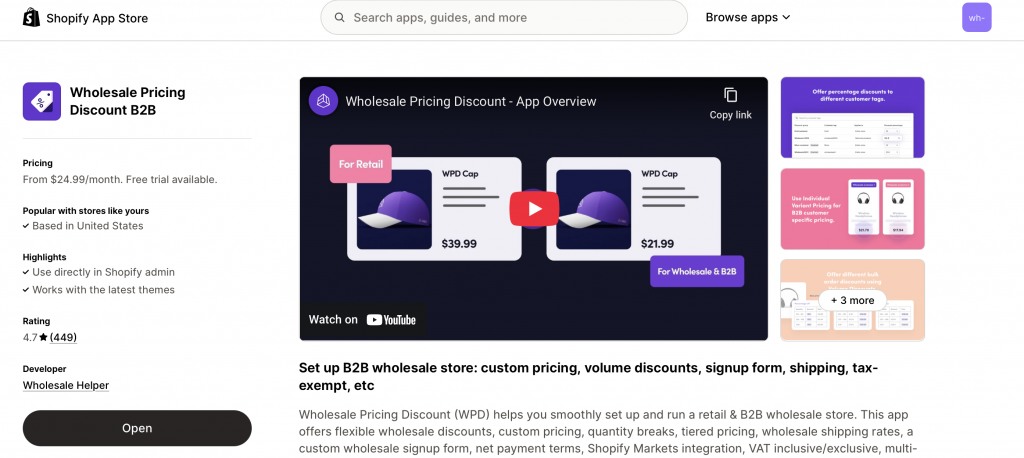
- Wholesale Pricing Discount B2B: Your core wholesale and B2B pricing engine.

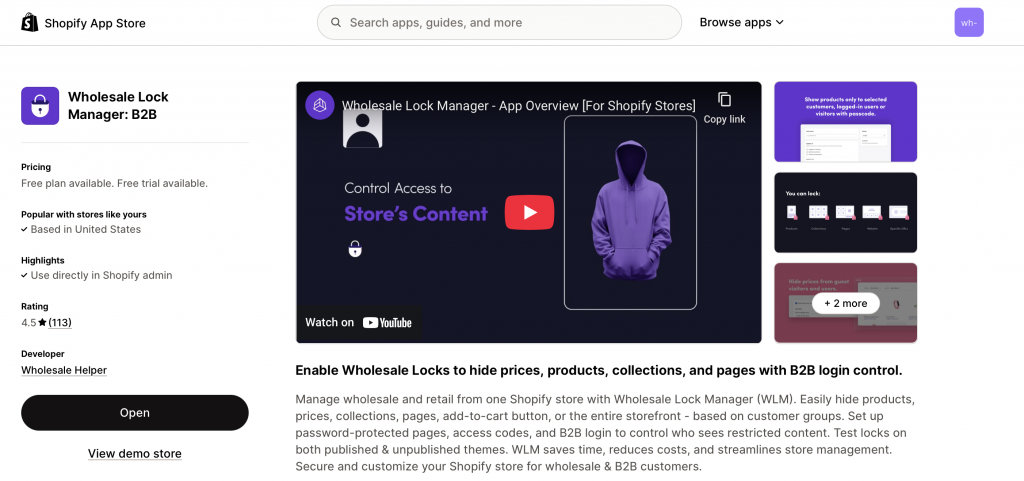
- Wholesale Lock Manager B2B: Hides wholesale prices from retail customers.

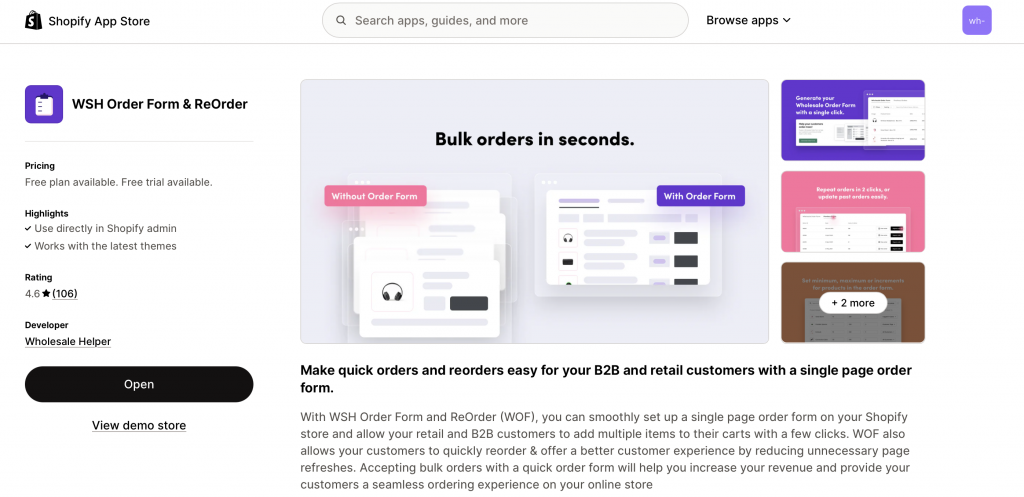
- WSH Order Form & ReOrder: Provides a fast, grid-style order form for quick bulk ordering and re-ordering.

Practical Tips:
- Use metafields to store key information like roast date, case quantity, and carton dimensions.
- Use tags to segment your product catalog into “Café (brew)” and “Retail (pack)” to keep your pricing logic clear.
Ready to impress your B2B customers? Start wholesaling like a pro! 🙂
Try our Wholesale Pricing Discount app for free !
Trusted by over 15,000 Shopify merchants
Summary – Wholesale Pricing for Coffee and F&B Business
A smart strategy for wholesale pricing for coffee business is all about getting the details right. Price your products based on your true landed cost, choose the right model for each type of buyer, and set your MOQs and tiers based on what makes sense for your production. Publish a clear policy on everything from freight to spoilage, and set it all up cleanly on Shopify. By protecting your margins at every step, you can build a thriving wholesale business that lasts.
Frequently Asked Questions about Wholesale Pricing for Coffee and F&B Business
How do I account for spoilage and damage in my pricing?
The best way is to build a spoilage allowance directly into your landed cost. For something like roasted coffee, a 1-3% allowance is a good starting point. For chilled items like cold brew, it might be higher—more like 3-6%. This money covers the cost of goods that are returned or expire, so your base wholesale price doesn’t take a hit.
What is a “scanback” or “promotional allowance”?
These are funds you set aside to help retailers promote your product. A scanback is a per-unit payment you give the retailer for every item they sell during a specific promotion. A promotional allowance is a lump sum you pay to cover the cost of a flyer or a special display. It’s smart to budget a small percentage (2-5%) of your revenue for these so you can participate in key promotions without having to slash your base wholesale price.
How should promotional deals be priced?
Try to be more inventive rather than simply lowering your wholesale price. You can make a value-driven bundle or provide a temporary discount on a particular product. To avoid teaching your customers to wait for a sale all the time, it’s important to keep your promotions brief and well-planned.
How do I deal with taxes and duties on international pricing?
Each country must have its own price list. In addition to adding any local taxes and tariffs to your landed cost for that particular market, your wholesale price should always be ex-VAT (ex-GST). Working with a local distributor or customs broker to assist you with the logistics is frequently the best option.
What should I offer my café partners beyond a good price?
Think of yourself as an extension of their business. Offer to train their baristas on how to brew your coffee perfectly. Provide them with tasting notes or origin stories to share with customers. This kind of support builds a stronger partnership and is often more valuable than a deep discount.