
Key Takeaways
- Basic, Grow, and Advanced Shopify stores can assign up to three active B2B catalogues in total with the Shopify Native B2B features.
- The 3-catalogue limit of Shopify B2B is shared across all markets. It is not three catalogues per market.
- Non-Plus stores cannot assign a catalogue directly to a specific company or company location.
- Three catalogues may be enough for a simple wholesale setup with a few broad pricing groups.
- Stores with negotiated prices, several buyer types, or regional pricing can outgrow the limit quickly.
- You can simplify your catalogue structure, use a wholesale pricing app like the Wholesale Pricing Discount B2B, upgrade to Shopify Plus, or combine different approaches depending on your setup.
Shopify’s April 2026 B2B expansion was a major improvement for merchants who are not on Shopify Plus. Stores on Basic, Grow, and Advanced can now use native company profiles, payment terms, quantity rules, volume pricing, purchase order numbers, reordering, and B2B catalogues.
However, there is a 3-catalogue limit of Shopify B2B that growing wholesale stores can reach surprisingly quickly.
This guide explains exactly how the Shopify B2B catalogue limit works, when it becomes a problem, and how to manage more complex wholesale pricing without immediately upgrading to Shopify Plus.
What Is a Shopify B2B Catalogue?
A Shopify B2B catalogue controls which products a group of wholesale buyers can purchase and the prices they receive.
A catalogue can be used to:
- Include or exclude specific products
- Apply an overall percentage price adjustment
- Set fixed prices for individual products or variants
- Add minimum, maximum, and incremental quantity rules
- Create quantity-based price breaks
- Control product availability for a B2B market
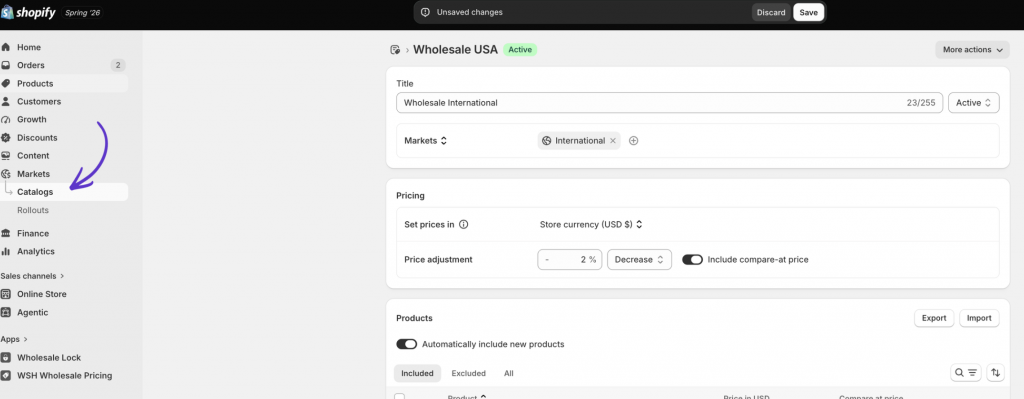
For example, a merchant could create one catalogue for standard retailers, another for distributors, and a third for high-volume accounts. This works well when buyers can be placed into a small number of clearly defined groups.
The problem starts when your pricing does not fit neatly into three groups.
How the 3-Catalogue Limit of Shopify B2B Actually Works
On Shopify Basic, Grow, and Advanced, you can assign up to three active catalogues across all your B2B markets.
You do not receive three catalogues for the United States, another three for the United Kingdom, and another three for Europe. The same three-catalogue allowance is shared across your entire B2B setup.
For example, imagine you assign the following catalogues to your US wholesale market:
- Standard retailers
- Distributors
- Key accounts
You have now used the full catalogue allowance. You cannot assign another active catalogue to a UK or European B2B market unless you remove or draft one of the existing assignments.
There is another important difference between standard Shopify plans and Shopify Plus. Basic, Grow, and Advanced, catalogues are assigned through B2B markets. You cannot assign a separate catalogue directly to one specific company or company location.
Why 3 Catalogues Can Become a Problem
Three catalogues may sound reasonable when you are setting up your first wholesale program. In practice, wholesale pricing often becomes more complicated as the business grows.
You Have More Than Three Buyer Types
A wholesale business might sell to:
- Independent retailers
- Regional distributors
- National distributors
- Hospitality businesses
- Corporate buyers
- Schools or nonprofit organizations
- Online resellers
- International partners
These buyers may not receive the same products, margins, minimum quantities, or payment arrangements. If each buyer type requires a different product and pricing combination, three catalogues will not cover the full setup.
Pricing Varies by Region
Regional pricing creates another layer of complexity. You may have standard and distributor pricing in the United States, separate prices in Canada, and a different wholesale structure for Europe. Even with only two customer types per region, you could need six different pricing combinations.
Some Customers Have Negotiated Prices
Wholesale pricing is not always based on a standard percentage discount. A large retailer might negotiate fixed prices for 20 products. A distributor may receive a better rate on one collection but standard pricing on everything else. A long-term account might have a custom price list based on an existing contract.
On non-Plus plans, you cannot simply create a catalogue and assign it directly to that individual company. You would need to place the buyer inside a broader market-based catalogue, adjust the surrounding pricing structure, handle the order manually, or use another pricing method.
Wholesale Pricing Changes Over Time
Your first wholesale structure will rarely remain unchanged forever. You may introduce:
- A new distributor tier
- Seasonal wholesale collections
- Country-specific price lists
- Special pricing for trade show accounts
- Different margins for a new product line
- Contract pricing for larger customers
Once all three catalogue slots are in use, every new pricing requirement forces you to reorganise the existing setup.
When Three Catalogues May Be Enough
The limit is not a problem for every merchant. Three catalogues may be enough when:
- Most wholesale customers receive the same discount
- You have only two or three clearly defined buyer groups
- Product access is similar across those groups
- Pricing does not change by country or region
- You do not negotiate customer-specific contracts
- Quantity breaks can handle the differences between small and large orders
For example, you might use:
- Catalogue 1 for standard wholesale buyers
- Catalogue 2 for distributors
- Catalogue 3 for VIP or strategic accounts
Within each catalogue, you can use fixed product prices and quantity price breaks instead of creating a separate catalogue for every level. This is often the cleanest native setup for a smaller wholesale operation.
Fixes for the 3-Catalogue limit of Shopify B2B for your Store
Fix 1: Move to Customer and Tag-Based Wholesale Pricing
When your pricing cannot fit into three broad categories, an app-based setup gives you another way to organise buyers. Instead of assigning a market catalogue, you can apply wholesale pricing based on customer tags, customer groups, products, variants, quantities, or individual accounts.
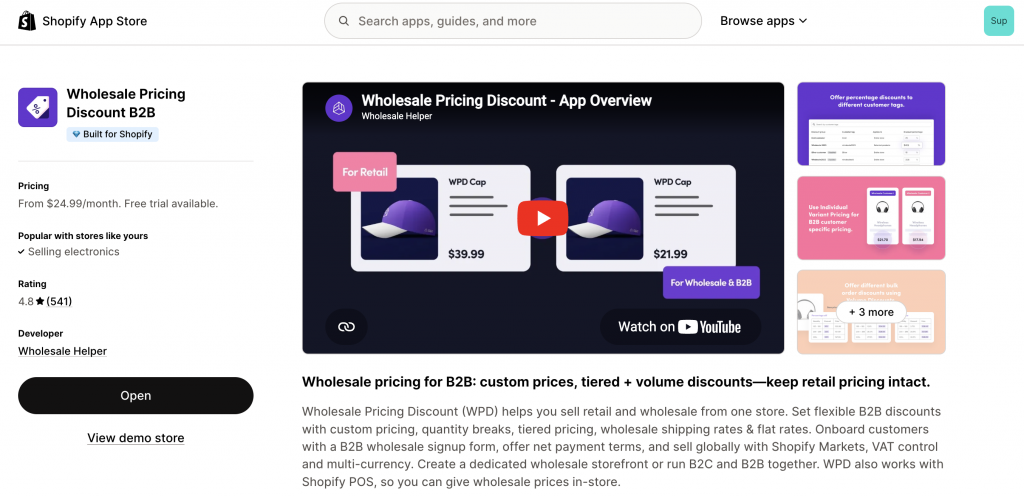
Wholesale Pricing Discount B2B supports unlimited customer groups, customer- and tag-based wholesale pricing, product-level discounts, variant pricing, volume discounts, order minimums, and per-customer pricing options, depending on the selected plan.
Fix 2: Use Native Shopify B2B and an App Carefully
Depending on your store configuration, you may continue using Shopify’s native b2b features; however, this type of setup needs careful testing. Avoid applying a native catalogue discount and an app-based discount to the same buyer without confirming how the rules behave together.
Fix 3: Upgrade to Shopify Plus
Shopify Plus removes the three-catalogue restriction and supports direct catalogue assignment to individual companies and company locations. However, needing a fourth pricing group does not automatically mean you need Shopify Plus. Also, for Shopify Plus, you end up paying more than $2,000/month, which can be expensive for most stores.
If the rest of your store does not require Plus, using a wholesale pricing app on Shopify may be a more proportionate way to handle additional groups.
When native B2B is not enough, Wholesale Pricing Discount B2B is the next step.
Try our Wholesale Pricing Discount B2B app for free !
Trusted by over 16,000 Shopify merchants
Summing Up
Shopify now gives Basic, Grow, and Advanced stores access to native B2B features, but these plans are limited to three active catalogues across all B2B markets. This can work well for stores with a small number of buyer groups, but it becomes difficult when pricing changes by customer type, region, product access, or negotiated contract.
Merchants can deal with this limit in a few ways. They can simplify their catalogue structure, use quantity breaks within the same catalogue, add a wholesale pricing app for customer- or tag-based pricing, or upgrade to Shopify Plus for unlimited catalogues and direct company assignments. For many growing stores, an app can offer more pricing flexibility without the higher cost of Shopify Plus.
Frequently Asked Questions
How many B2B catalogues can I have on Shopify Basic?
Shopify Basic stores can assign up to three active catalogues across all B2B markets. The same limit applies to Grow and Advanced stores.
Is the three-catalogue limit per B2B market?
No. The three active catalogues are shared across all your B2B markets. Assigning all three catalogues to one market uses the complete allowance.
Can I assign a catalogue directly to one company?
Direct catalogue assignment to a specific company or company location is available on Shopify Plus. Basic, Grow, and Advanced stores assign B2B catalogues through Markets.
Can one Shopify B2B catalogue contain several pricing levels?
Yes. You can use fixed product prices, quantity rules, and quantity price breaks inside a catalog. This can reduce the need to create separate catalogues for every order-volume tier.
Do I need Shopify Plus if I need more than three wholesale pricing groups?
Not necessarily. You can use a wholesale pricing app to create additional customer groups and pricing rules on a standard Shopify plan. Shopify Plus may make more sense when you also need direct catalogue assignments, advanced payments, contextual B2B experiences, or other enterprise features.
Can I use Shopify B2B catalogues and a wholesale pricing app together?
Some stores may use native B2B features alongside app-based pricing, but the setup should be tested carefully. Make sure native and app-based discounts do not overlap or produce inconsistent prices at checkout.