
Key Takeaways
- Setting up wholesale prices for clothing brands starts with landed cost. Include fabric, trims, CMT, packaging, freight, duties, warehousing, QA, samples, returns, and defect allowance.
- Most clothing retailers expect around a 50–60% margin, which usually means the wholesale price lands around 40–50% of MSRP.
- Apparel pricing should account for size runs, prepacks, case packs, fabric differences, decoration costs, and seasonal markdown risk.
- Shopify now supports B2B features on Basic, Grow, Advanced, and Plus plans, but plan limits still matter. Basic, Grow, and Advanced support up to 3 active B2B market catalogs, while Plus supports unlimited B2B market catalogs and direct company catalog assignment.
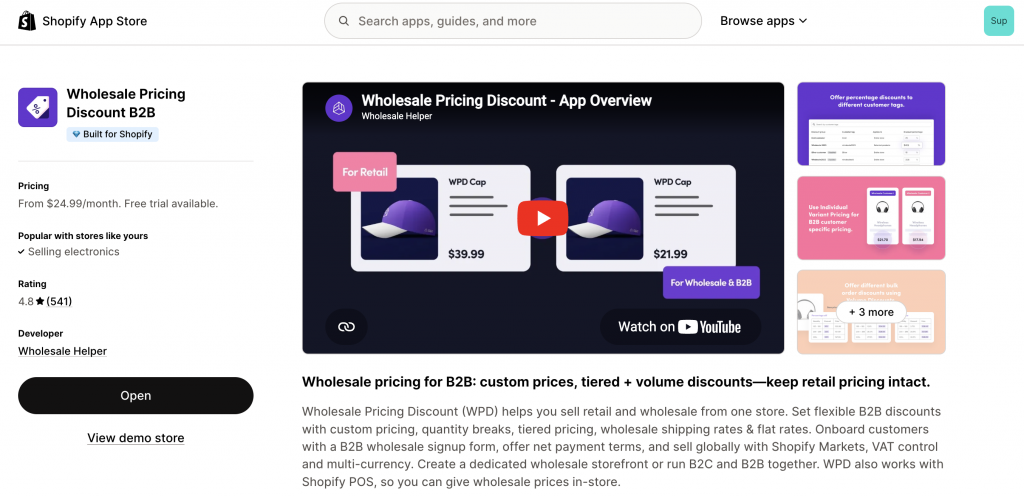
- Wholesale Pricing Discount B2B is useful when clothing brands need customer-specific pricing, variant-level pricing, quantity breaks, MOQs, shipping rules, net terms, Shopify Markets, VAT/tax controls, multi-currency, and POS wholesale pricing. The app is Built for Shopify, starts at $24.99/month, and has a 4.8 rating from 546 reviews.
To set effective wholesale prices for clothing brands on Shopify, start with an accurate landed cost. Next, you can use that figure to determine an accurate wholesale price that leaves you a healthy profit while still giving your retailer a strong margin off the MSRP.
This guide explains how to set wholesale prices for clothing brands on Shopify in 2026, including landed cost, MSRP, retailer margin, size runs, MOQs, price breaks, and Shopify B2B setup.
The Core Challenge: Balancing the Three Key Numbers
Setting wholesale prices for clothing brands isn’t just about picking a number; it’s a careful balancing act between three figures:
1. Your landed cost,
2. Your wholesale price, and
3. Your product’s MSRP (Manufacturer’s Suggested Retail Price).
Clothing retailers typically expect a 50-60% margin, which means your wholesale price must be low enough to leave them room to make a profit while still covering all your costs and target margin.
Let’s break down how to get it right.
The 5 Steps to Setting Wholesale Prices For Clothing Brands
1) Get Your Landed Cost Right (No Guesswork Allowed)
Your landed cost is the total, per-unit cost of getting a finished product to your warehouse door. It’s the most critical number in this entire process.
Calculate your landed cost by adding up every single expense:
- Raw Materials: Fabric, trims, buttons, labels.
- Manufacturing: The CMT (cut-make-trim) or factory price.
- Finishing: Polybags, hangtags, brand labels, and packaging.
- Inbound Freight & Duties: The cost to ship the goods from the factory to your warehouse, including any import duties or customs fees.
- Handling: The cost of warehousing, picking, and packing each unit.
- Overhead: A small allowance for payment processing fees, quality assurance, and sampling.
Mini Example (Unisex Tee, per unit):
| Cost Element | Amount |
| Fabric + Trims + CMT | $6.80 |
| Packaging & Tags | $0.30 |
| Freight & Duty (US) | $0.70 |
| Warehouse & Handling | $0.40 |
| Overheads Allowance | $0.80 |
| Total Landed Cost | $9.00 |
Pro Tip: Keep a simple spreadsheet where you can track costs by region. This is crucial if you’re shipping to the EU, for example, where you need to account for import VAT on arrival.
2) Anchor Your Pricing Strategy (Retail-First or Wholesale-First)
Once you have your landed cost, you can decide on your pricing strategy. You can use a Wholesale Price Calculator for this. Most brands use one of two approaches:
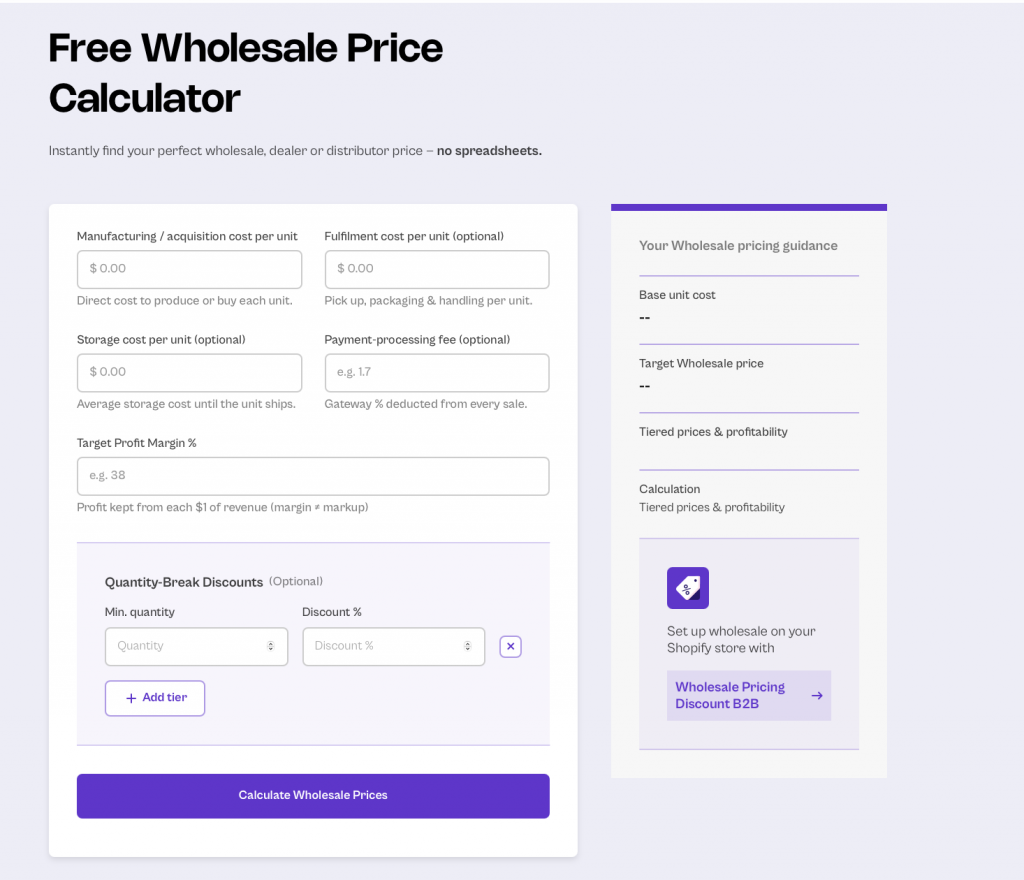
- Retail-First (Backsolving): This is the most common method for DTC-heavy brands. You start with the MSRP that the market will bear. If your market dictates a $50 MSRP and your retailer expects a 50% margin, then your wholesale price has to be around $25. With your $9.00 landed cost, this leaves you a healthy gross margin of 64% at wholesale.
- Wholesale-First (Rolling Up): You start by setting a target wholesale margin that you need to be profitable (often 55-65% for clothing). You then work backward to set a wholesale price and an MSRP that gives the retailer a competitive margin.
Formulas You’ll Use:
- Your Margin: (Wholesale Price – Landed Cost) ÷ Wholesale Price
- Retailer Margin: (MSRP – Wholesale Price) ÷ MSRP
3) Design Apparel-Friendly Price Breaks and MOQs
Keep your pricing structure simple and familiar to clothing buyers. Don’t overcomplicate things with too many tiers.
A Starter Template for a Tee or Hoodie:
- Minimum Order Quantity (MOQ): 24 units per style, or a “pack” of four 6-packs with a standard size curve.
- Price Breaks:
- 24+ units: Base wholesale price (e.g., $25)
- 72+ units: 5% off the base price
- 144+ units: 8-10% off the base price
- Sizing Options: Offer a standard size curve (e.g., 1-2-3-3-2-1 for XS–XXL) or allow open sizing with a smaller MOQ per size.
This structure works because apparel buyers think in terms of “packs” and “size curves,” and simple tiers are easier to understand and manage. If you offer custom embroidery or printing, keep those “decoration fees” separate from your base pricing to protect your core margin.
4) Implement Your Pricing on Shopify
Now it’s time to put your strategy into practice. There are a few methods to implement your pricing on Shopify.
Using Shopify Native B2B Features: As of 2026, Shopify has launched a few basic B2B features natively on its platform, and they are available on all plans. They include company-based catalogues, volume discounts, net terms, and more. However, there are certain limitations, such as the 3 catalogue limit, which would ultimately require serious wholesale businesses to either upgrade to the $2000 per month Shopify Plus plan or use 3rd party apps.
- Use Wholesale Pricing Discount B2B to set automated, customer-specific prices, quantity breaks, and MOQs.
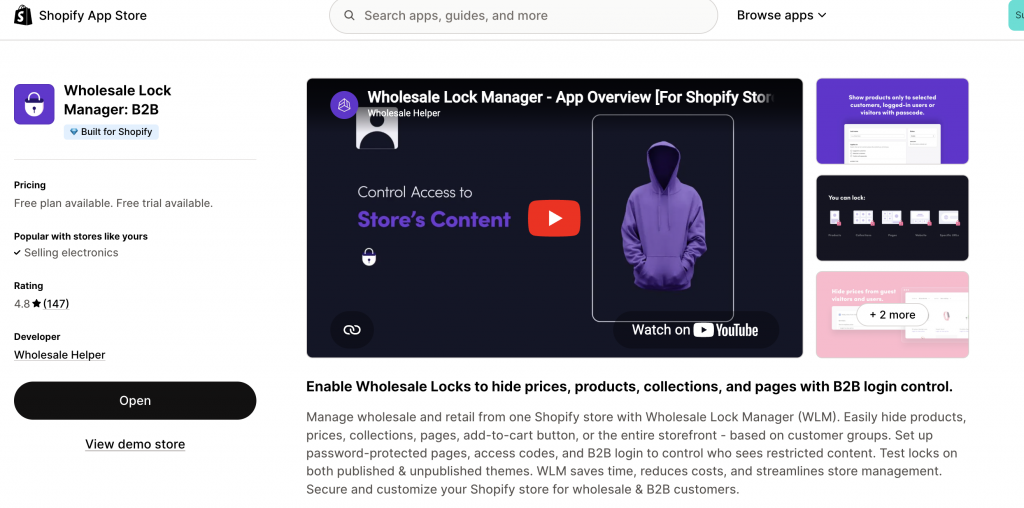
- Use Wholesale Lock Manager B2B to hide your wholesale catalog and prices until a buyer is logged in and approved.
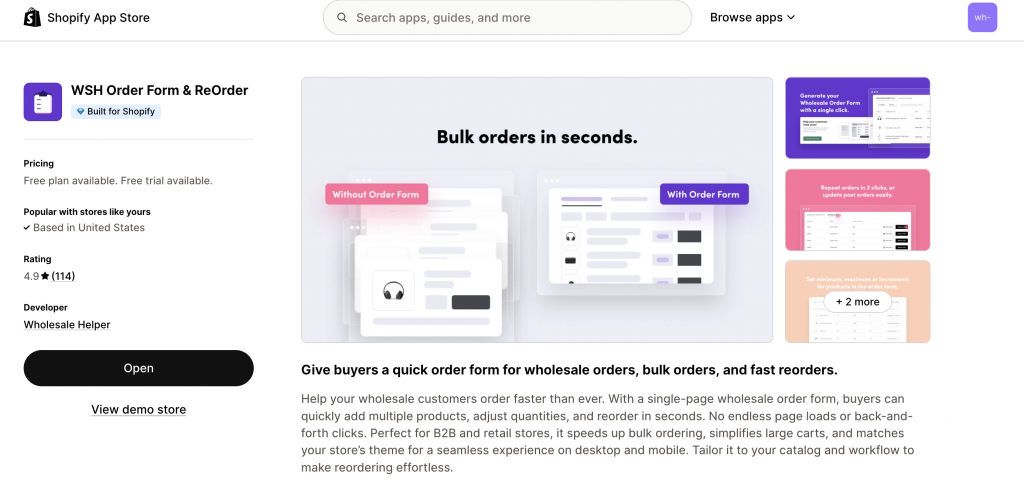
- Use WSH Order Form & ReOrder to give your buyers a fast, grid-style ordering experience for bulk purchases.
Pro Tip: Keep your collections clean (e.g., “Core Tees,” “Fleece”) to make it easier for buyers to navigate and for you to manage pricing.
5) Test with Real Accounts and Review Monthly
Before you launch your pricing to everyone, run a pilot program.
- Pilot Group: Invite a few key buyers (a boutique, an online retailer, etc.) to place an order.
- Check and Verify: Watch them check out to ensure the prices, discounts, and tax calculations work correctly after they log in.
- Measure: Track your average order value, how often customers meet your MOQs, and your reorder rate.
- Iterate: If buyers are consistently pushing back on a specific price or MOQ, use that feedback to make small adjustments to your pricing tiers before rolling it out to your entire wholesale network.
Real Example Walk-Through
Let’s say you’re launching a Unisex Heavy Tee:
- Your Landed Cost (US): $9.00
- Your Target Margin: You want to leave a 50% margin for the retailer off the MSRP.
- MSRP: You set your MSRP at $50.
- Wholesale Price: To hit the 50% retailer margin, your wholesale price is $25. Your profit margin is 64%—perfect.
- Pricing Tiers:
- 24+ units → $25
- 72+ units → $23.75 (5% off)
- 144+ units → $23.00 (8% off)
- Shopify Setup: You assign a “Wholesale” customer tag and set these tiered prices in your wholesale app. You also use a lock manager to hide the collection until the buyer logs in.
When native B2B is not enough, Wholesale Pricing Discount B2B is the next step.
Try our Wholesale Pricing Discount B2B app for free !
Trusted by over 16,000 Shopify merchants
Frequently Asked Questions
How much of a wholesale discount off MSRP is normal?
For clothing, wholesale price is often around 40–50% of MSRP. That usually gives retailers around 50–60% margin. The exact number depends on product category, brand positioning, channel, seasonality, and retailer expectations.
How many pricing tiers should I use for quantity breaks?
Two or three clear tiers are enough for most clothing brands. For example, 24 units, 72 units, and 144 units. Too many tiers can confuse buyers and make pricing harder to manage.
How do I handle custom embroidery or screen printing costs?
Keep decoration fees separate from base wholesale pricing. Embroidery, screen printing, patches, labels, private label packaging, and setup fees can change by design complexity, thread count, color count, placement, and order quantity. Separating them protects your base garment margin.
How do I handle VAT/GST for my wholesale prices?
For B2B, it is usually cleaner to show wholesale prices before VAT/GST where relevant, then let tax apply based on the buyer’s location and tax status. UK and EU retailers may discuss MSRP as VAT-inclusive, so keep MSRP and wholesale tax treatment clear on your line sheet and Shopify store.
How do I handle different landed costs for international orders?
Create separate landed cost assumptions by region. A UK, EU, US, or Australia order may have different freight, duties, VAT/GST handling, warehousing, returns, and compliance costs. If costs differ significantly, create separate wholesale pricing for each market instead of simply converting currency.
What if I sell items with different manufacturing costs?
Calculate landed cost by product, not only by category. A tee, hoodie, denim jacket, embroidered cap, and extended-size garment can all carry different fabric, trim, labor, freight, and defect costs. Use product-level or variant-level pricing where needed.