
US-focused overview. Rules vary by state and by supplier. This is practical guidance, not legal or tax advice.
Key Takeaways:
Can you buy wholesale without a business license?
Sometimes, yes. Many suppliers will still sell to you, but they may treat you like a normal consumer buyer and charge sales tax. In many cases, you’ll also get smaller quantity breaks or slightly higher pricing until you’re set up for resale.
What do wholesalers usually require instead of a “business license”?
Most commonly, they want a resale certificate (or proof you’re registered for sales & use tax) so they can document why they did not collect sales tax on the sale to you.
Is it illegal to buy wholesale without a business license?
Buying in bulk is not illegal. Problems usually arise when someone incorrectly claims a tax exemption or misuses a resale certificate for items they do not resell.
What is the cleanest route if you plan to resell?
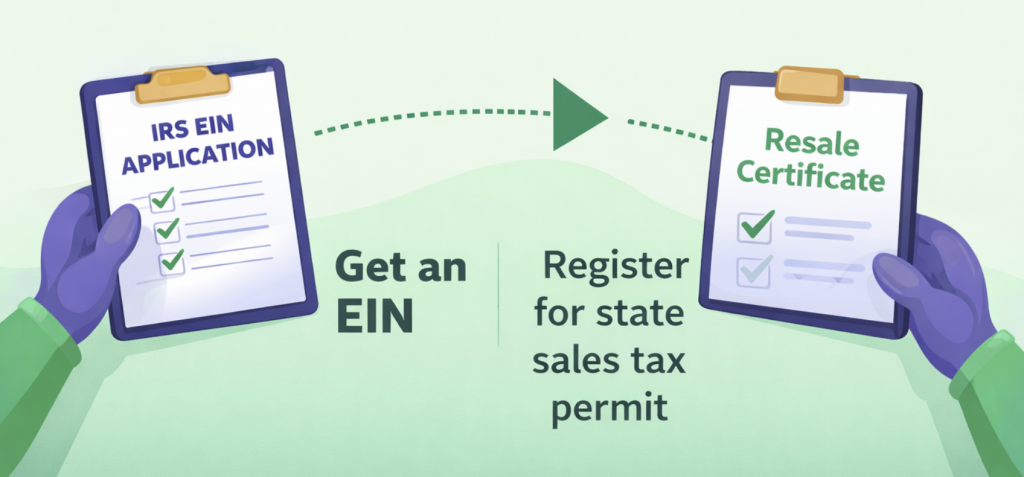
If you plan to resell seriously in the US, the clean path is usually to get an EIN, register for the right state sales tax permit where required, and use resale certificates correctly. The IRS says you can apply for an EIN directly through the IRS for free.
A lot of people search for this because they want wholesale pricing from suppliers, but they are not fully set up as a business yet. Maybe you are testing a product idea. Maybe you are buying bulk inventory for a small side hustle. Or maybe you want to compare supplier pricing before registering everything properly.
The important thing to understand is this: when a supplier asks for a “business license,” they may not mean one specific document.
In the US, many wholesalers actually care more about resale documentation. This can be called a resale certificate, reseller permit, seller’s permit, sales tax ID, or sales and use tax permit depending on the state. The reason is simple. If the supplier sells to you tax-free for resale, they need proper documentation to support why they did not collect sales tax.
This guide explains when you can buy wholesale without a business license, when you should not, and what to set up if you want to resell products the right way.
What wholesalers mean by “business license” (most of the time)
When a wholesaler says, “Do you have a business license?”, they might be referring to different things depending on the supplier and the state they operate in.
| Document | What it means | Who usually issues it | When you may need it |
|---|---|---|---|
| Local business license | Permission to operate in a city or county | City or county | Some local areas require it before you operate a business |
| EIN | Federal tax ID for your business | IRS | Useful for opening business accounts, forming entities, hiring, and some tax filings |
| Sales tax permit or seller’s permit | Registration to collect and remit sales tax | State tax authority | Usually needed when you sell taxable goods and have sales tax obligations |
| Resale certificate | Document used to buy goods for resale without paying sales tax upfront | State or accepted multi-state certificate | Used when you buy products tax-free because they will be resold |
| Business registration | Entity registration such as LLC or corporation | State | Needed if you form a legal business entity |
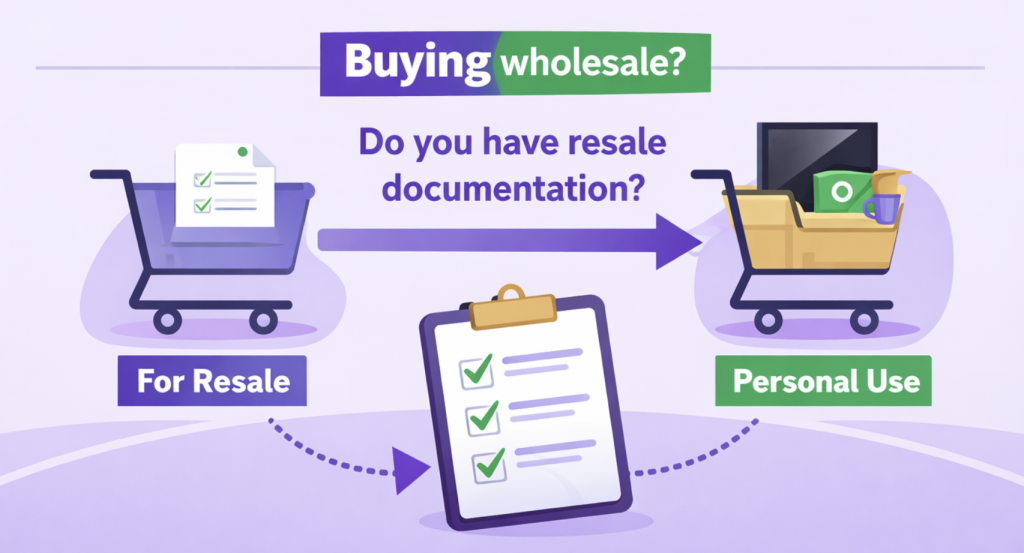
The confusing part is that suppliers often use “license” as a catch-all word. If your goal is specifically buying inventory for resale, the document that usually matters most is resale documentation, not a local business license.
When you can buy wholesale without a business license
You can often buy “wholesale” (or at least get bulk pricing) without paperwork in these situations, as the seller is treating you like a retail buyer and charging sales tax.
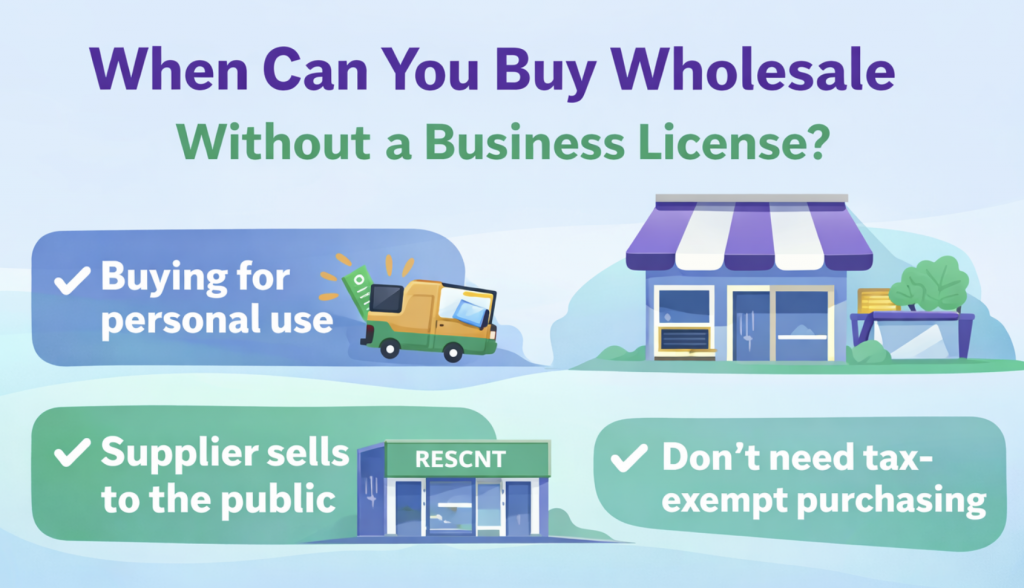
1) You are buying for personal use (not resale)
If you are buying for yourself, you can still find bulk options. You may buy case packs, get volume discounts, or use warehouse pricing. In that situation, you should expect to pay sales tax like any normal purchase.
2) The supplier sells to the public
Some wholesalers are strict, but others sell to anyone as long as you meet their minimum order quantity rules, buy full cases, or pay upfront. In those cases, you can often access product and pricing without being “registered.”
3) You’re not asking for tax-exempt purchasing
This is an important distinction. Many suppliers get strict when you ask for tax-free resale purchasing, because they need the right paperwork on file.
When you usually can’t (or shouldn’t) buy wholesale without paperwork
1) When you want to buy inventory tax-free for resale
In the US, if you want to purchase inventory without paying sales tax upfront, you typically need a resale certificate or equivalent state documentation. Sellers rely on those certificates as evidence that they did not owe sales tax on that sale.
2) When the supplier is protecting a dealer network
Many brands only sell wholesale to verified retailers because they do not want their products flipped on marketplaces, discounted publicly, or sold by random accounts with no customer support. In those categories, verification is often about brand protection, not taxes.
3) When you are tempted to “borrow” someone else’s resale certificate
This is where people get into trouble. Resale certificates are meant for purchases that will be resold, and many states make it clear that if you buy tax-exempt and then use the items personally, you may owe use tax.
So yes, you might be able to buy wholesale without a license, but using someone else’s paperwork is not the smart workaround.
Quick decision table: “Can I buy wholesale without paperwork?”
| Situation | Can you buy? | Sales tax charged? | What to expect | Best next step |
|---|---|---|---|---|
| Personal bulk buying | Usually yes | Yes | Bulk pricing, not true wholesale terms | Buy case packs or volume deals |
| Testing products before starting | Often yes | Yes | Smaller discounts and limited supplier access | Validate demand and margins |
| Reselling but paying sales tax | Often yes | Yes | Higher cost basis | Get properly set up once serious |
| Reselling and asking for tax exemption | Usually no | Not if valid paperwork is accepted | Supplier will ask for resale documentation | Get sales tax permit and resale certificate |
| Brand with dealer protection | Often no | Depends | Strict approval and verification | Apply as a retailer or dealer |
| Liquidation or closeout buying | Often yes | Usually yes | Low prices but inconsistent inventory | Use for testing, not stable supply |
7 Legit Ways to Buy Wholesale (or get wholesale-like pricing) without a Business License
Below are seven ways to access bulk pricing without formal resale paperwork. In most cases, you should assume you’ll pay sales tax and you may receive shallower pricing tiers than verified resale accounts.
1) Start with bulk packs from regular retailers
This lets you learn whether a product sells, how shipping behaves, and whether unit economics work before you chase supplier accounts.
2) Buy from suppliers that allow consumer purchases
Some distributors sell without business verification. Expect sales tax and weaker tier pricing until you’re set up for resale.
3) Use liquidation or closeout channels carefully
Liquidation can give low unit costs without credentials, but inventory can be inconsistent. It’s a fast way to test; it’s rarely a stable supply plan.
4) Work with local manufacturers who sell direct
Smaller manufacturers may be flexible when you place case-size orders and pay upfront. This can be a strong early path in categories like home goods and basic apparel (and sometimes food/beauty when compliance requirements are met).
5) Attend markets or trade events that allow general admission
Some shows have public days or cash-and-carry areas. Just keep expectations realistic: you may not get long-term wholesale terms without proper resale registration later.
6) Ask for a starter wholesale program
Some brands start you on smaller opening orders at slightly higher pricing, then move you to deeper wholesale terms once you prove consistent reorders. If they say no, it’s often channel protection rather than a judgment on you.
7) If you plan to resell seriously, do the basic setup
This is the most sustainable option. Once you have the right documentation, suppliers treat you like a real account, your pricing improves, and you avoid messy gray-area workarounds
If your goal is resale, you can also read our full guide on how to buy wholesale products to resell before choosing suppliers.
If you’re reselling: the simple, legit setup (US-focused)
If you are buying inventory to resell, even small amounts, then you will usually need to handle sales tax properly. This is the clean path many sellers use.
Step 1: Get an EIN (often helpful, and free if you apply directly)
An EIN is a federal tax ID. The IRS explicitly notes you can get an EIN directly from them and warns people to avoid sites that charge for it.
Step 2: Register for your state sales tax permit (where required)
Sales tax registration is state-specific. If you’re required to collect sales tax in a state, you generally need to register with that state’s tax authority. (Your location and activity determine what applies.)
Step 3: Use resale certificates correctly
A resale certificate is meant for purchases that will be resold. It generally should not be used for items you will use or consume in your business, and items bought under resale may become subject to use tax if you end up using them.
Step 4: If you operate in multiple states, know that certificates are not universal
Some multi-state certificates exist, but acceptance varies by state and by scenario:
Streamlined Sales Tax (SST) member states accept the SST exemption certificate form.
The Multistate Tax Commission (MTC) Uniform Sales & Use Tax Resale Certificate lists states that indicate they accept it, with instructions and limitations.
(This is not legal or tax advice. Use this as a practical overview, and confirm details for your state.)
If you’re a wholesaler (seller): How to handle buyers who don’t have a license
This comes up all the time for Shopify merchants. You want to sell wholesale, but you do not want random shoppers seeing wholesale pricing, and you need a clean way to approve buyers.
A practical setup usually looks like this:
- Your retail store stays open for everyone.
- Wholesale access is gated behind a simple application.
- Approved buyers get wholesale pricing and a wholesale ordering experience.
What to collect on the wholesale application (simple version):
- Business name + website/social proof (if any)
- State(s) you’ll ship to / resell in
- Intended sales channels (storefront, wholesale accounts, marketplaces, etc.)
- Resale certificate only if the buyer is asking for tax-exempt purchasing
- Contact details for invoicing/support
On Shopify, many merchants handle this with:
- a wholesale registration form (to collect business details and documents),
- a locked wholesale area (so wholesale pricing isn’t public),
- and account-based pricing rules for approved buyers.
If you’re using Wholesale Helper apps, a common stack is:
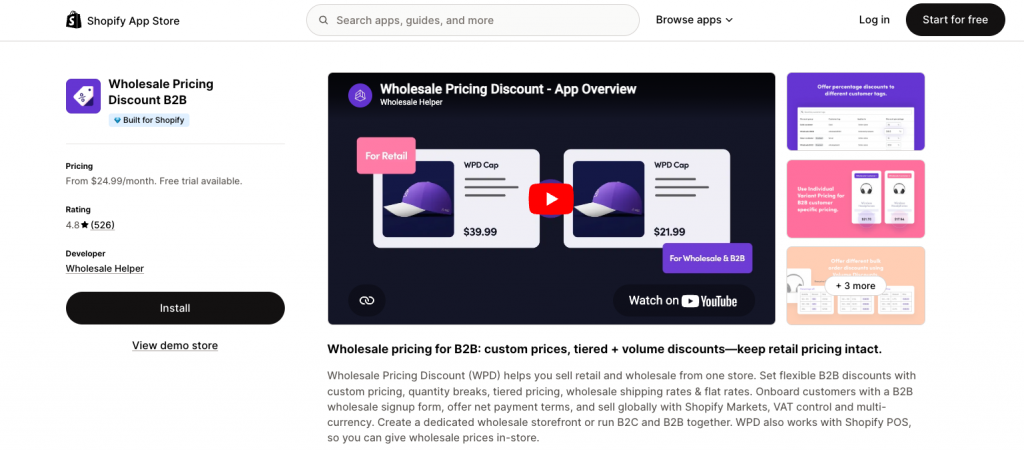
- Wholesale Pricing Discount B2B for customer-specific pricing/discounts and wholesale registration workflows.
- Wholesale Lock Manager: B2B to restrict products/pages/collections so wholesale access isn’t public.
(Keep it simple: approval + gating + pricing. Everything else is optional.)
Summary
If you are buying in bulk for personal use, you can often access bulk pricing without any paperwork. In most cases, you will simply pay sales tax like a normal customer and follow the supplier’s minimum order rules.
If you are buying inventory to resell, the biggest unlock is not a “business license” in the generic sense. The real unlock is having the right resale documentation so suppliers can sell to you correctly for tax purposes. Once you have that set up, wholesale accounts become easier to open, pricing becomes more consistent, and you avoid the messy gray-area workarounds that create problems later.
When native B2B is not enough, Wholesale Pricing Discount is the next step.
Try our Wholesale Pricing Discount app for free !
Trusted by over 16,000 Shopify merchants
Frequently Asked Questions
Is a business license the same as a resale certificate?
No. A business license usually gives you permission to operate in a city, county, or state. A resale certificate is used to buy products for resale without paying sales tax upfront.
Can I buy wholesale for personal use?
Yes, if the supplier allows it. You should expect to pay sales tax because you are not buying the products for resale.
Can I use someone else’s resale certificate?
No. Do not use another person’s resale certificate. Resale certificates should only be used by the business or person they belong to and only for valid resale purchases.
What happens if I buy tax-free but do not resell the products?
You may owe use tax or face other state-level issues depending on the rules where you operate. This is why resale certificates should only be used for products you genuinely plan to resell.
What is the easiest way to start buying wholesale legally in the US?
A common route is to get an EIN, register for your state sales tax permit if required, and use resale certificates correctly when buying inventory for resale.
Can Shopify sellers approve wholesale buyers before showing prices?
Yes. Shopify sellers can collect wholesale applications, review buyer details, and show wholesale pricing only after approval. This can be done with Shopify B2B company account requests, custom workflows, or wholesale apps.