


Key Takeaways:
What is Shopify wholesale?
Shopify wholesale is a B2B selling model where merchants offer bulk pricing to business buyers through a Shopify store using tiered pricing, volume discounts, customer-specific price lists, and minimum order quantities for retailers, distributors, and resellers.
Can I run both a retail and wholesale store on a single Shopify store?
Yes. Shopify lets you sell to both retail and wholesale customers from one store by using customer logins, approval flows, and pricing rules that show different prices, products, or collections to B2B buyers without affecting retail shoppers.
Can you sell wholesale on Shopify without Shopify Plus?
Yes. You can sell wholesale on Shopify without Shopify Plus by using third-party wholesale apps that support customer-specific pricing, tiered and volume discounts, wholesale logins, and essential B2B workflows on standard Shopify plans.
What type of features should a Shopify wholesale store have?
A well-built Shopify wholesale store combines custom B2B pricing, customer-group-based discounts, wholesale logins, bulk ordering tools, and app integrations that manage pricing visibility and wholesale workflows efficiently. Read more about features >
How do I set up a wholesale store on Shopify?
You can run a Shopify wholesale store by choosing between Shopify Plus or a third-party wholesale app, depending on your scale and budget. Most merchants use apps to add B2B pricing, customer access, and bulk ordering without changing their existing Shopify plan.
This guide explains how to set up and run a Shopify wholesale store, including B2B pricing, volume discounts, customer access, and wholesale workflows. It covers the key features a wholesale setup should include and the different ways merchants can implement wholesale on Shopify, with or without Shopify Plus.
How Shopify Supports Wholesale Selling
Shopify supports wholesale selling in two main ways: native Shopify B2B features and third-party wholesale apps.
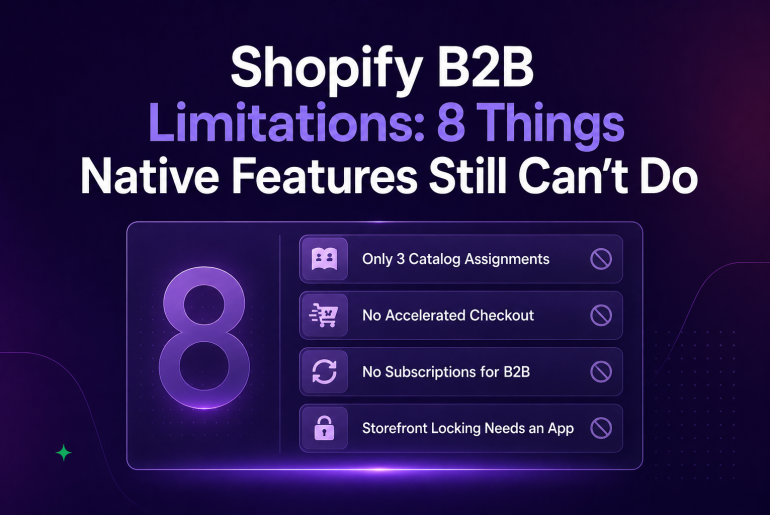
Native Shopify B2B now works across Basic, Grow, Advanced, and Shopify Plus plans, but the feature limits are different by plan. For example, Basic, Grow, and Advanced stores can use B2B catalogs through Shopify Markets, while Shopify Plus gives more advanced control, including unlimited B2B market catalogs and direct catalog assignment to specific companies or company locations.
Shopify B2B can help merchants manage:
- Companies and company locations
- B2B catalogs
- Quantity rules
- Quantity price breaks
- Net payment terms
- Payment reminders
- PO numbers
- Draft order to invoice
- Checkout to draft
- Easy reorders
- Sales staff permissions
Wholesale apps remain extremely useful when merchants need greater control over the storefront. For example, a store may need customer-tag pricing, login-to-view-price rules, hidden products, wholesale registration forms, locked pages, bulk order forms, or a simpler setup for selling retail and wholesale from one Shopify store.
For many merchants, the best setup is not “Shopify B2B vs apps.” It is using the right mix of both.
Why Shopify Works Well for Wholesale Selling
Shopify works well for wholesale because many merchants already use it for retail. That makes it easier to add B2B selling without building a separate wholesale website from scratch.
A Shopify wholesale setup can support bulk pricing, customer-specific discounts, company accounts, catalogs, volume pricing, payment terms, and private product access depending on the plan, apps, and workflow you choose.
This is helpful if you sell to retailers, distributors, dealers, stockists, corporate buyers, or repeat B2B customers.
Shopify also gives merchants flexibility. Some stores use native B2B features. Some use wholesale apps. Some use both. The right setup depends on how buyers order, how pricing is managed, and whether the store is retail-only, B2B-only, or a blended B2B and D2C store.
Live Shopify wholesale store examples
Below are some successful examples of Shopify wholesale stores that use different wholesale setups to sell products in bulk to B2B customers. Each example highlights a common wholesale pattern that merchants can replicate on their own Shopify stores.
1. Botaone
Botaone is a Shopify-based brand focused on Korean skincare and haircare products. The store offers wholesale pricing for bulk purchases and maintains a dedicated wholesale section for approved B2B buyers, allowing retailers and distributors to place larger orders at discounted rates.
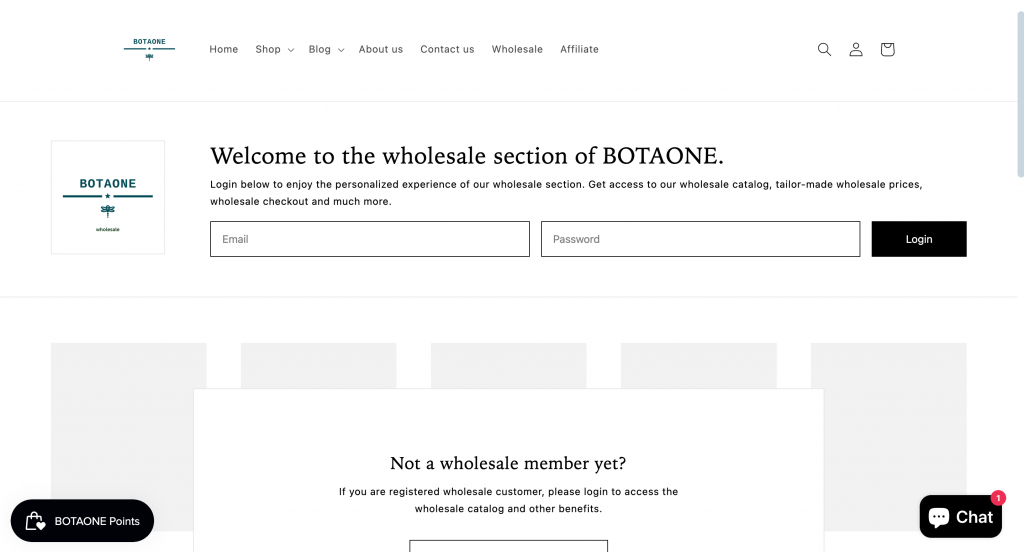
Wholesale pattern: Dedicated wholesale section + bulk purchase discounts
2. OCN Distribution
OCN Distribution uses Shopify to support wholesale ordering for physical media manufacturing and fulfillment. The company provides a separate wholesale customer onboarding form, enabling businesses to apply for wholesale access and receive a more personalized B2B buying experience.
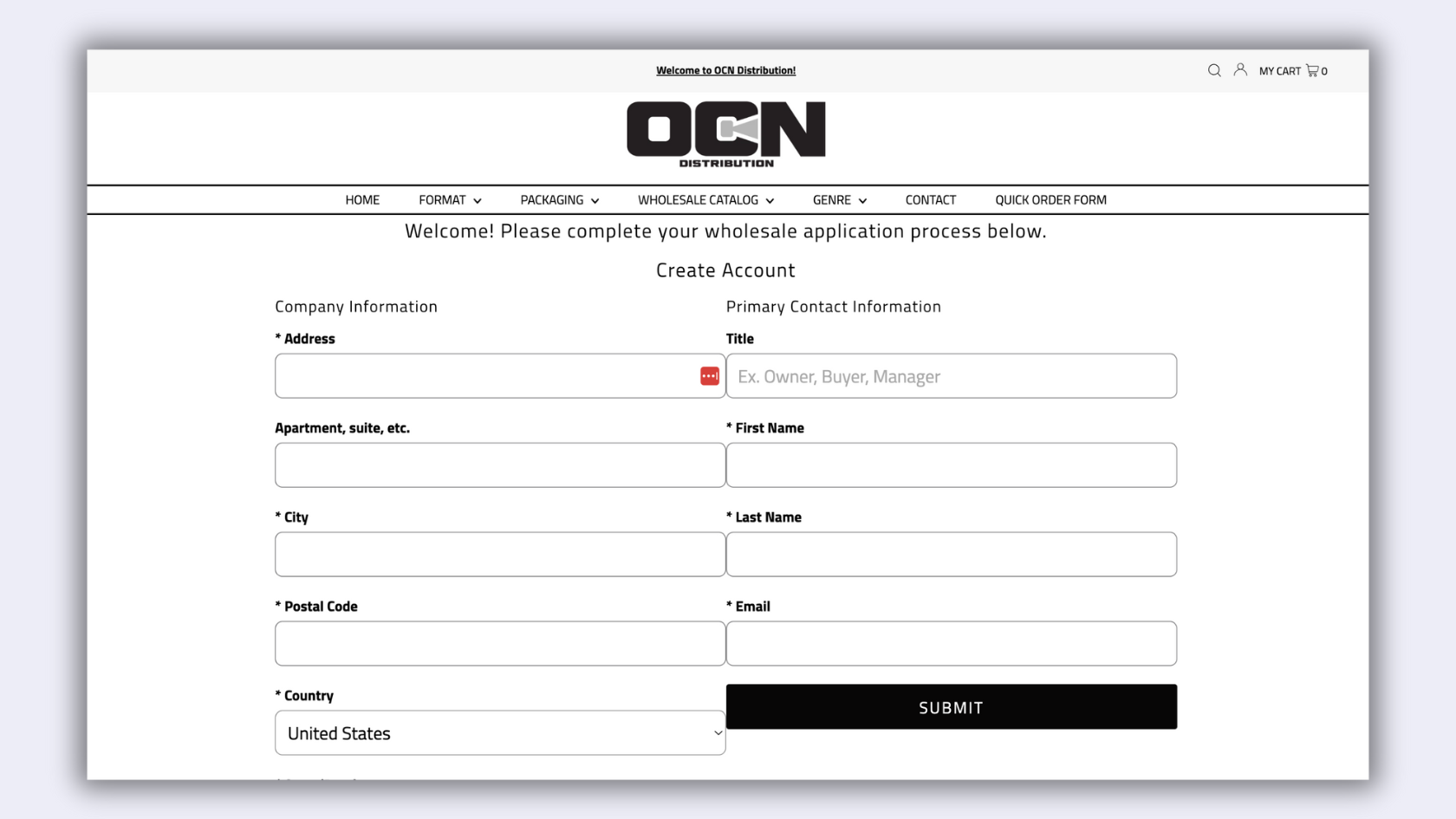
Wholesale pattern: Wholesale registration and approval workflow
3. The Nut Garden
The Nut Garden sells food products such as nuts, chocolates, and candies through its Shopify store. The business supports wholesale sales by offering bulk discounts and a wholesale order form that allows B2B customers to place large orders efficiently.
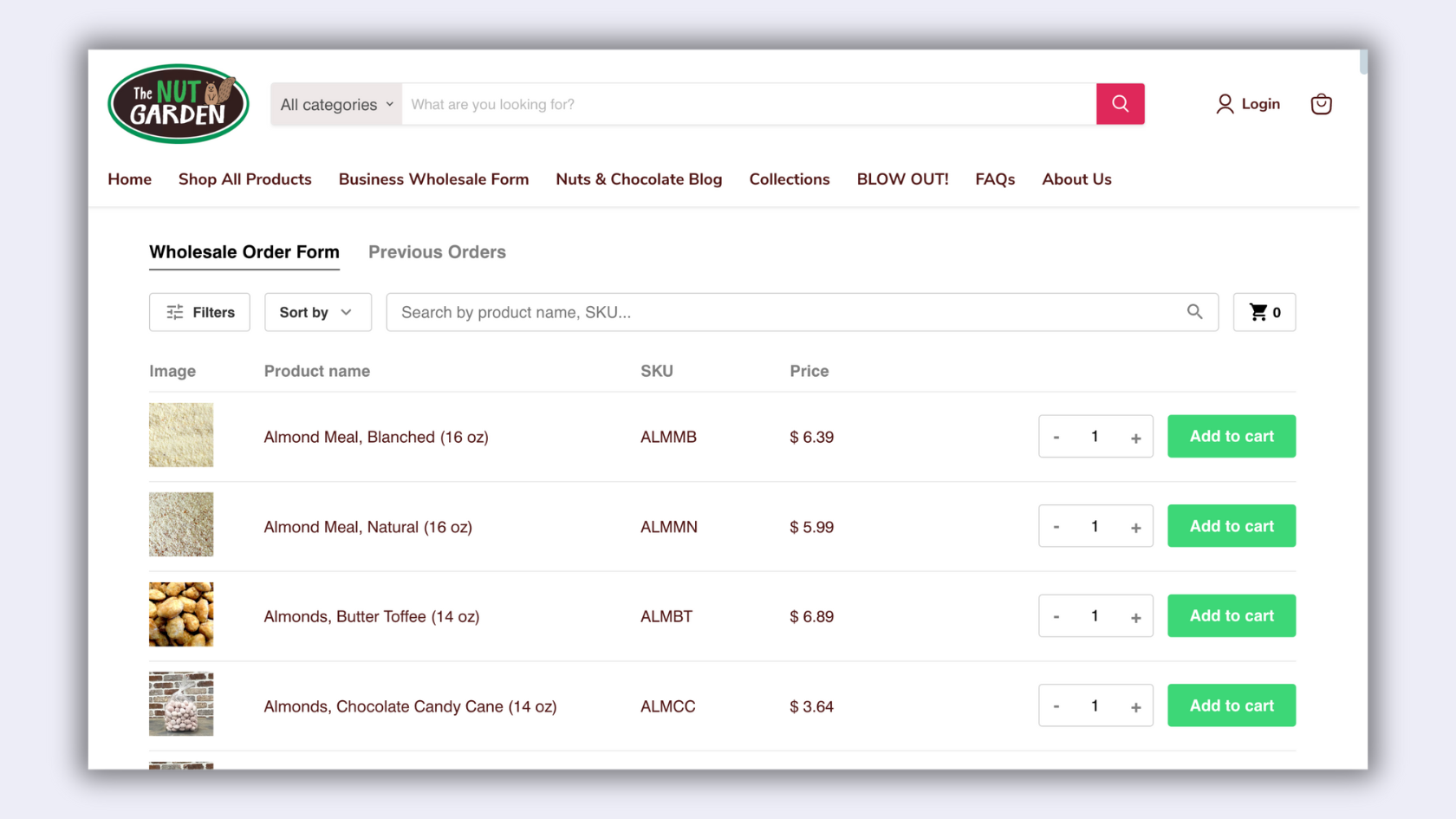
Wholesale pattern: Bulk discounts + wholesale order form
4. Modloft
Modloft sells modern furniture items through a Shopify storefront and offers wholesale pricing to approved B2B customers. Wholesale buyers must apply through a dedicated account creation form to access wholesale pricing and place bulk orders.
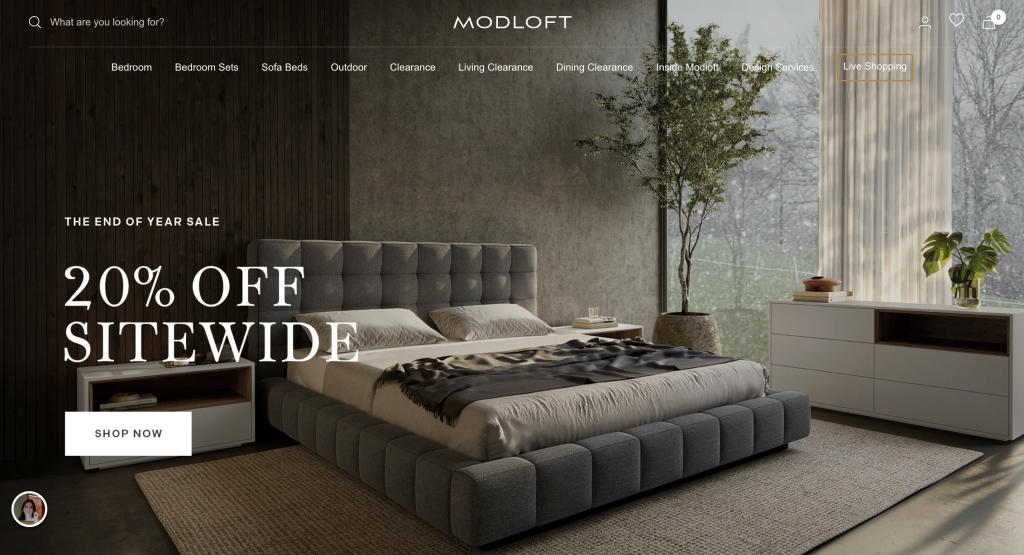
Wholesale pattern: Wholesale signup + restricted pricing access
Why these examples matter?
These Shopify wholesale stores demonstrate that wholesale can be implemented in multiple ways, through pricing rules, customer approval flows, or dedicated order forms, while still operating from a single Shopify store. Merchants can choose the wholesale setup that best matches their products, buyers, and operational needs.
How to Sell Wholesale on Shopify (Step-by-Step)
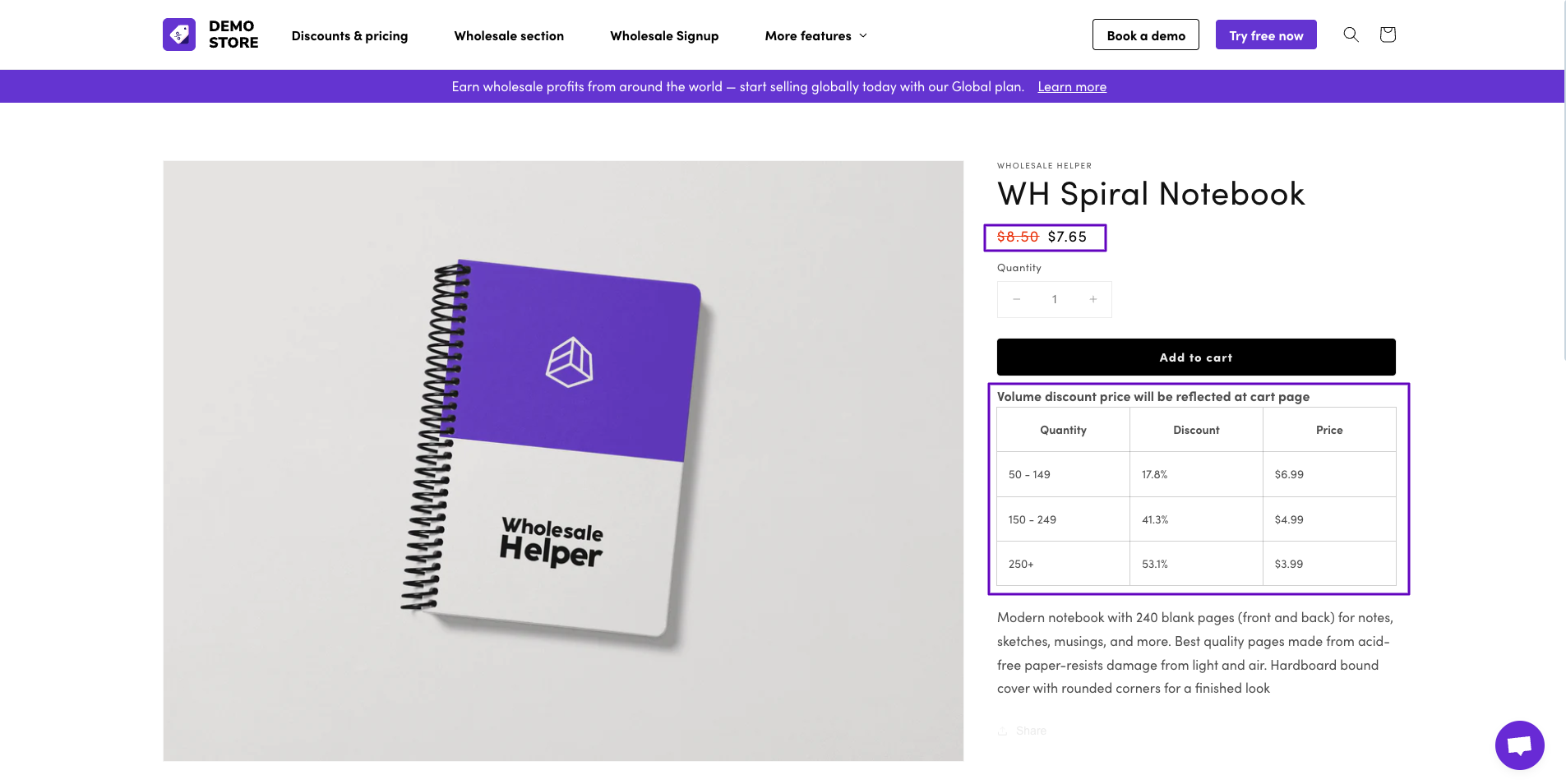
Selling wholesale on Shopify typically involves preparing your store, choosing how you’ll handle B2B pricing, and setting up customer access and ordering workflows. Below is a practical five-step process most merchants follow to launch wholesale alongside retail from a single Shopify store.
Step 1: Prepare Your Shopify Store
Before setting up wholesale, you need a working Shopify store with the basics in place. This includes:
i. An active Shopify account
ii. A connected domain name
iii. Products ready for wholesale sale
iv. Payment and checkout configuration
If you already run a Shopify store, you can skip this step. Wholesale features are usually added on top of an existing retail setup rather than built from scratch.
Step 2: Choose a Theme and Configure Store Content
Your Shopify theme should support clear product layouts and flexible customization for wholesale content. Most modern Shopify themes work well for wholesale when paired with the right pricing and access controls.
At this stage, merchants typically:
i. Upload products and variants
ii. Add clear product descriptions and images
iii. Ensure the cart and checkout experience works smoothly for larger orders
No wholesale-specific theme is required, but clarity and usability matter for B2B buyers placing bulk orders.
Step 3: Decide How You’ll Run Wholesale
Shopify wholesale can be set up in a few ways. You can use native Shopify B2B features, wholesale apps, or a mix of both.
Native Shopify B2B is useful when you want to manage companies, company locations, catalogues, quantity rules, volume pricing, payment terms, PO numbers, draft orders, and B2B reorders inside Shopify.
Wholesale apps are useful when you need more storefront control or a workflow that is easier to manage without custom development. For example, apps can help you:
i. Show different prices to wholesale customers
ii. Apply discounts using customer tags
iii. Hide prices until login
iv. Lock products, collections, or pages
v. Add wholesale registration forms
vi. Create bulk order forms
vii. Offer reorder tools
viii. Manage wholesale pricing without rebuilding the store
If you are on Basic, Grow, or Advanced, check which native B2B features are available for your plan. Shopify’s current B2B plan table shows that many B2B features are now available across plans, but some advanced features are still Plus-only.
A practical way to decide is this:
i. Use native Shopify B2B if you want company-based buying, catalogues, terms, and B2B checkout workflows.
ii. Use wholesale apps if you want flexible pricing rules, locked access, forms, order forms, or more control over your storefront.
iii. Use both if your store has a more complex B2B and retail setup.
Step 4: Set Wholesale Pricing and Discount Rules
Once you’ve created your Shopify store, you need to set wholesale pricing and discounts on your products.
Here are some use cases of offering wholesale pricing/discount types:
i. Custom product pricing
ii. Free shipping thresholds
iii. Quantity-based pricing/discount
iv. Volume discounts
v. Wholesale bundle discounts
vi. Limited time wholesale deals
vii. Minimum order discounts
viii. Buy one, get one offers
ix. Pricing based on specific customer tags
x. Individual product variant pricing
Wholesale pricing is the price that wholesalers charge for products. Wholesalers typically buy products from suppliers in bulk and then sell those products to customers at a higher price.
Step 5: Set Up Wholesale Customer Access and Onboarding
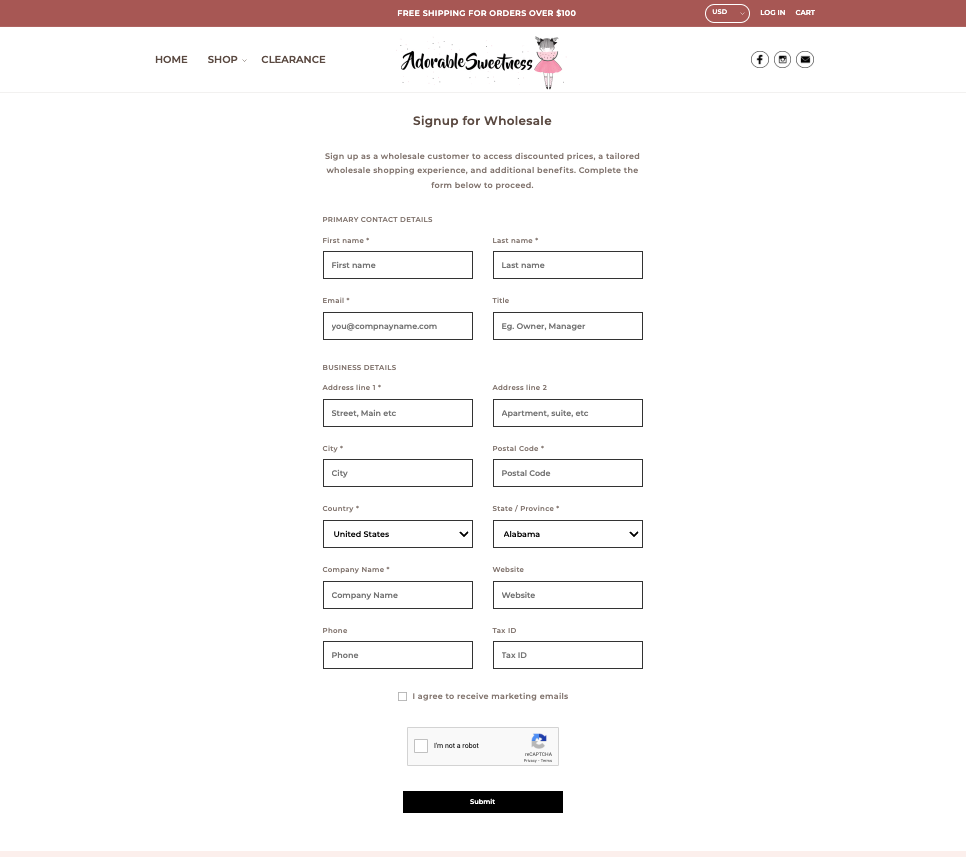
Once pricing rules are in place, the next step is controlling who can access wholesale pricing. Most Shopify wholesale stores do this through a registration or approval process.
Common approaches include:
i. Wholesale signup forms
ii. Manual approval of B2B customers
iii. Customer tags that unlock wholesale pricing after login
This ensures only approved wholesale buyers can view discounted prices and place bulk orders, while retail customers continue to see standard pricing.
Bonus: Restrict or Hide Wholesale Content When Needed
If you have more specific requirements, for example, hiding certain products, prices, collections or specific pages from your specific retail customers, there are ways to lock or hide pages on Shopify.
You can also use a third-party app like Wholesale Lock Manager B2B, which will help you do this without requiring any coding knowledge.
Useful Shopify wholesale apps to consider
Wholesale apps make it easy to sell wholesale on Shopify. Here are six of the best Shopify wholesale solutions for businesses:
1. Wholesale Pricing Discount B2B
Wholesale Pricing Discount B2B app is one of the best wholesale apps for Shopify store owners that want to integrate a wholesale experience in their stores. The app offers many good features such as custom pricing, minimum quantity discount, set flat price for products, wholesale signup form, etc., making it a complete B2B wholesale solution.
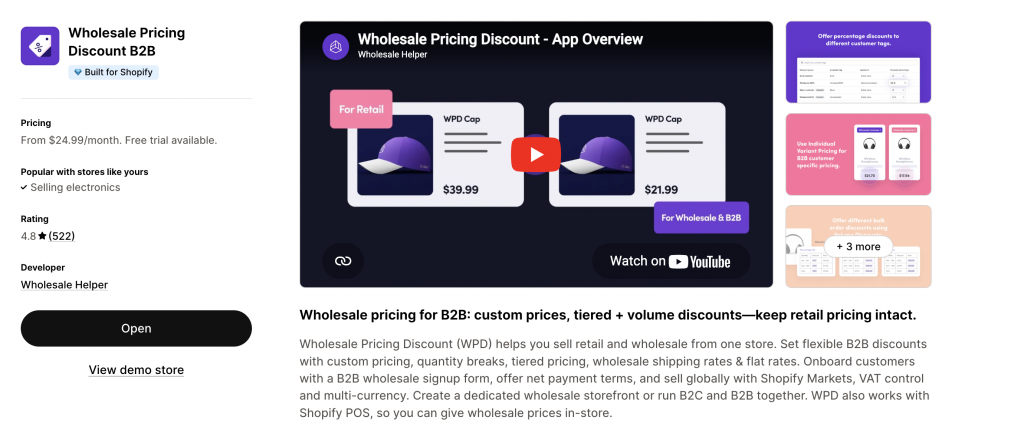
Features
- Discount groups
- Volume discounts
- Individual variant discount
- Wholesale signup form
- Offer net payment terms
- Shopify Markets Integration
Pricing
- 14-day free trial is available
- Basic plan – $24.99 per month
- Professional plan – $44.99 per month
- Enterprise plan – $49.99 per month
- Global plan – $64.99 per month
2. WSH Order Form & ReOrder
With the WSH Order Form & ReOrder, you receive an interface to take custom orders from your wholesale or B2B customers. This app offers you many useful features such as total customization of form fields, adding barcodes and SKUs, setting increment quantity per ‘+’ click for product add to cart, and much more.
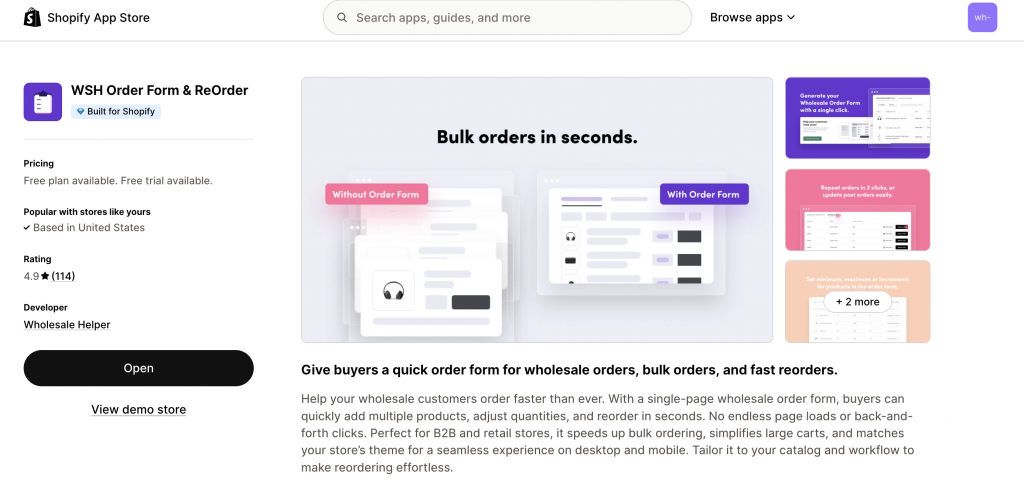
Features
- Take bulk orders
- Repeat order or update past orders
- Set minimum, maximum, or qty. increments for products
- Customize the order form to match your website
Pricing
- Free for development and trial stores
- 8-day free trial is available
- Basic plan – $15.99 per month
- Professional plan – $19.99 per month
- Enterprise plan – $24.99 per month
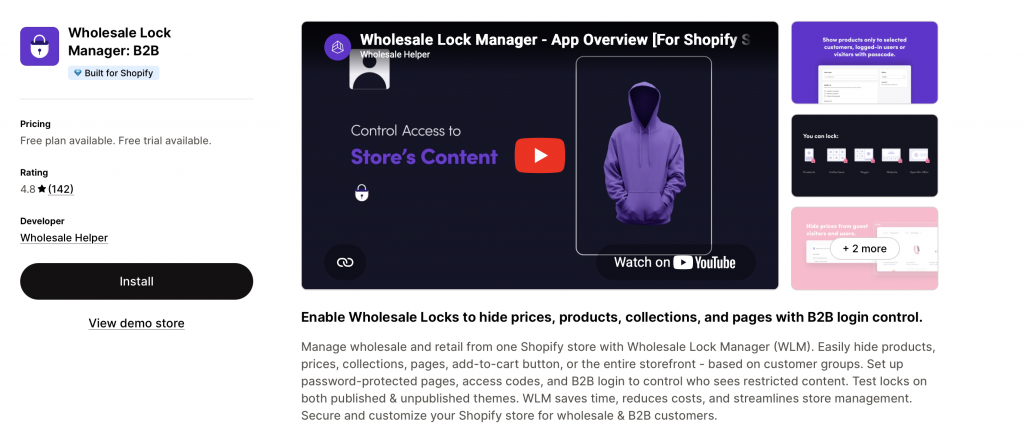
3. Wholesale Lock Manager
Wholesale Lock Manager allows Shopify store owners to lock or hide pages on their store. It also offers other features that can make the store or specific pages password-protected.
Features
- Hide or lock products from your retail customers
- Show products to only selected customers, logged-in users, and visitors with a passcode
- Lock products, collections, pages, specific URLs, and the entire store
- Hide product prices from website visitors and users
Pricing
- 7-day free trial is available
- Free for development and trial stores
- $9.99 per month
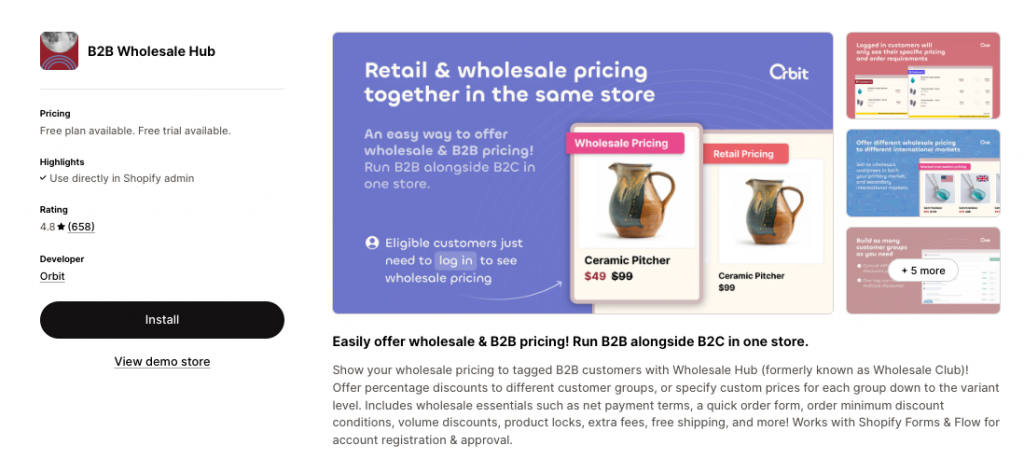
4. B2B Wholesale Hub
Using B2B Wholesale Hub, store owners can add wholesale functionality to their stores and show custom pricing to signed-in customers. There are other important features too.
Features
- Login to see wholesale pricing
- Create discounts connected to customer tags
- Create multiple discount groups
- Hide product prices from website visitors and users
- Shopify POS compatible
Pricing
- 14-day free trial available
- Basic plan – $39 per month
- Professional plan – $69 per month
- Premium plan – $99 per month
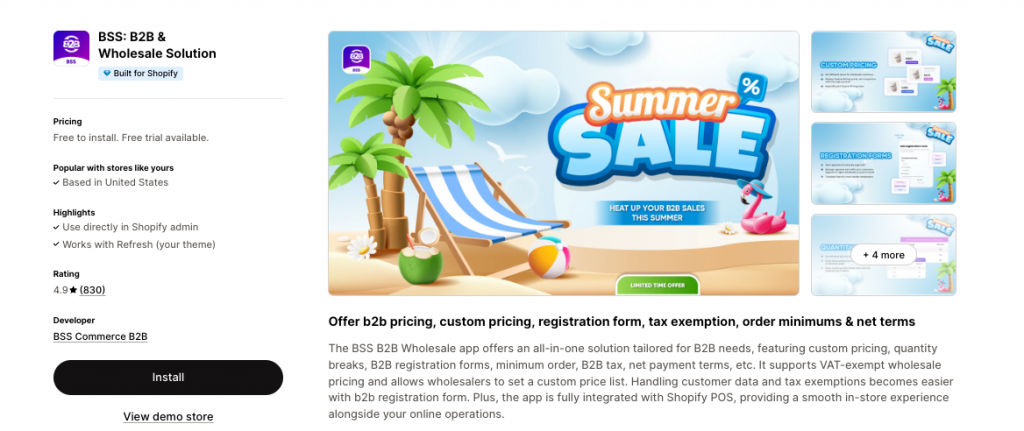
5. BSS: B2B & Wholesale Solution
This is another widely used wholesale app that offers b2b features to Shopify businesses that want to run seamless wholesale operations on their store.
Features
- Display unlimited quantity breaks
- Accept wholesale accounts manually
- Autotag wholesale customers/orders
- Order limits
- Variant based pricing
- Form conditional logic
- API for pricing
Pricing
- 14-day free trial available
- Free plan for development and partner stores
- ESSENTIAL PLAN – $25 per month
- ADVANCED PLAN – $50 per month
- PLATINUM – $100 per month
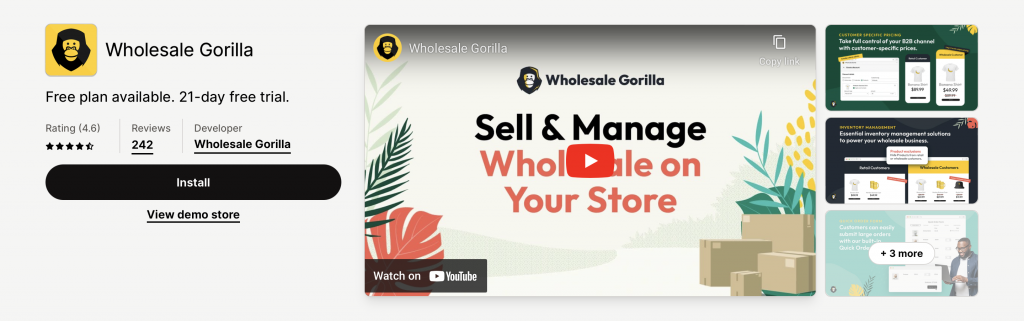
6. Wholesale Gorilla
The Wholesale Gorilla app is designed to provide a wholesale experience to the store owners. This app also offers features such as wholesale pricing and order management and more.
Features
- Override shipping of retail settings with wholesale shipping
- Quick order form
- Hide products from wholesale/retail customers
- Place an order and pay later
- Wholesale registration form
Pricing
- 21-day free trial available
- Essential plan – $34.95 per month
- Advanced plan – $69.95 per month
- Premium plan – $149.95
When native B2B is not enough, Wholesale Pricing Discount B2B is the next step.
Try our Wholesale Pricing Discount B2B app for free !
Trusted by over 16,000 Shopify merchants
Summary
Shopify wholesale is no longer only about choosing between Shopify Plus and third-party apps.
As of 2026, Shopify supports many native B2B features across Basic, Grow, Advanced, and Plus plans. This includes companies, catalogs, quantity rules, quantity price breaks, net terms, payment reminders, PO numbers, and easy reorders. Some advanced controls, such as direct company catalogs and advanced payment features, are still limited to Shopify Plus.
For many merchants, the best setup is a mix of native Shopify B2B features and wholesale apps.
Use Shopify B2B when you want company-based buying, catalogs, payment terms, PO numbers, and B2B checkout workflows. Use apps when you need more control over storefront visibility, customer-tag pricing, wholesale forms, locked products, and bulk ordering.
The main thing is to keep the buyer experience simple. Approved wholesale customers should be able to log in, see the right pricing, order in bulk, and pay using the terms you have approved for them.
FAQs
What is Shopify wholesale?
Shopify wholesale means selling products in bulk to business buyers through a Shopify store. These buyers may include retailers, distributors, dealers, stockists, corporate buyers, or resellers.
Do I need Shopify Plus for wholesale?
Not always. Shopify B2B is now available on Basic, Grow, Advanced, and Plus plans, but features vary by plan. For example, Basic, Grow, and Advanced support up to 3 active B2B market catalogs, while Plus supports unlimited catalogs and direct company catalog assignment.
What features should a Shopify wholesale store have?
A Shopify wholesale store should usually have customer approval, wholesale pricing, quantity rules, volume discounts, customer-specific access, bulk ordering, payment terms, PO numbers, and a clear reorder flow.
Can I run retail and wholesale from the same Shopify store?
Yes. Many merchants run retail and wholesale from the same Shopify store. Shopify calls this a blended B2B and D2C setup. You can show normal retail pricing to public shoppers and B2B pricing to approved wholesale customers after login.
Can Shopify support wholesale quantity rules and volume pricing?
Yes. Shopify B2B supports quantity rules and volume pricing through catalogs. Quantity rules can set minimums, maximums, and increments, while volume pricing can offer price breaks when customers buy larger quantities.
What is the difference between Shopify B2B and wholesale apps?
Shopify B2B is Shopify’s native system for companies, catalogs, payment terms, PO numbers, and B2B checkout workflows. Wholesale apps are useful when merchants need extra storefront control, customer-tag pricing, locked products, hidden prices, registration forms, or bulk order forms.




8 Comments
You’ve written it so nicely, and you’ve come up with some great ideas. This is a fantastic post!
I am glad that you found the post informative! Thank you very much for your comment 🙂
You’ve got some very amazing insights, and it’s really put together well. You did a great job on this post!
hello , thanks for this article , i just want to ask you , is it ok to share this article on my facebook page ?
Hello , thanks for sharing this nice article , i really enjoy your way in writing , can you pleas tell how to subscribe in your website ?
Shopify absolutely sucks for wholesale. I’ve spent more time over the past two years testing, implementing, and being disappointed with wholesale apps (from the app store) for the standard tiers of Shopify than I care to remember. What you fail to mention is that Shopify Plus costs a minimum of $2,000/mo … and it’s awesome, if you can afford it—Plus wasn’t built for small businesses. Every penny of development and every suggested feature is wrapped into Plus. Shopify standard tiers haven’t seen a single significant upgrade in nearly a decade.
Nothing, and I mean nothing, in the standard tiers (Basic through Enterprise) is set up to help small business owners be successful. The basic system is worthless until you start spending money on apps for basic features that every online store needs to be able to sell online. I would dump Shopify in a heartbeat if there was a comparable option, especially for wholesale. All of the examples you give above are patches that fall short in one way or another.
Hey Paul,
As a Shopify wholesale app provider, we understand your frustrations and concerns. It’s disheartening to hear that your experience with wholesale apps on Shopify’s standard tiers hasn’t met your expectations. While Shopify Plus offers robust features tailored for larger enterprises, we acknowledge that it may not be feasible for every business due to its cost.
We strive to bridge the gap between the needs of small businesses and the capabilities of our wholesale apps. Our aim is to provide essential features and support to help businesses succeed, regardless of their size or budget constraints. We continuously listen to feedback from merchants like you to improve our offerings and address pain points.
While we understand your desire for a comparable alternative. And we’re committed to enhancing our wholesale solutions to better serve your needs.
We encourage you to share specific features or functionalities you believe are lacking so we can work towards addressing them. Your feedback is invaluable in guiding our development efforts and ensuring we provide a platform that empowers businesses to thrive in the competitive e-commerce landscape.
Check our wholesale apps here: https://apps.shopify.com/partners/goldj
🙂
The B2B limitations breakdown is the most useful part of any Shopify wholesale explainer, and you list the actual gotchas rather than glossing over them. Saving this to revisit when we set up our own tiered pricing.