
Key Takeaways
- In the wholesale auto parts business, you need accurate fitment data, strong supplier terms, clear warranty rules, freight planning, and return workflows.
- Your pricing should include sourcing cost, packaging, freight, duties, warehouse cost, warranty reserve, RMA cost, core handling, and hazmat or oversize surcharges where relevant.
- Fitment accuracy is one of the biggest operational risks. Wrong year/make/model/engine fitment can create returns, angry buyers, and warranty disputes.
- Some auto parts have extra compliance needs. Emissions-related parts, catalytic converters, batteries, airbags, chemicals, and safety-related equipment need careful handling before you sell them online.
- Shopify can support B2B auto parts selling, but you need the right setup for customer-specific pricing, locked trade pricing, bulk ordering, PO numbers, net terms, and quick reorders.
The wholesale auto parts industry is huge and growing rapidly due to increased demand for vehicles worldwide. Selling auto parts wholesale online isn’t just about listing products; it’s about building a business model that can handle complex logistics, margins, and policies.
This step-by-step guide walks you through everything you need to get started, from defining your model and supply chain to setting profitable pricing and launching your online store.
Step 1: Define Your Business Model
Before building your online presence, decide what kind of wholesale operation you want to run:
- OEM vs Aftermarket: OEM parts (from original manufacturers) often carry higher trust but tighter margins, while aftermarket parts can give you more flexibility and profit.
- Commodity vs Niche: High-turn items like brake pads, filters, and fluids move in volume, but margins are thinner. Specialty or performance parts may sell more slowly but command higher margins.
- Customer Type: Are you supplying retailers, local repair shops, fleets, or performance enthusiasts? Each has different expectations on pricing, order sizes, and delivery.
Defining these choices upfront keeps you from stretching your resources too thin and gives your pricing and policies a clear direction.
Step 2: Set Up Operations & Supply Chain
Once you’re done with deciding your business model, the next step is to set up some solid operations and supply chain management processes. Do the following to plan accordingly:
- Sourcing & Vendors: Build relationships with reliable manufacturers or remanufacturers. Negotiate not just cost, but also warranty support and freight terms.
- Inventory & Warehousing: Decide whether you’ll stock inventory yourself, use a 3PL, or rely on a hybrid model. Small, high-turn items like filters may suit 3PLs, while bulky or fragile parts (struts, exhausts) often need more control.
- Freight & Accessorials: Plan early for LTL/FTL shipments, liftgate services, and hazmat surcharges (important for fluids, batteries, and airbags). These extras can eat into margins if not priced in.
- Return Logistics: Core returns, warranty claims, and fitment errors are all part of the business. Laying out clear return workflows now prevents costly disputes later.
With your supply chain mapped out, you can confidently move on to the most critical pillar, and that is your pricing model.
Step 3: Price Your Parts Profitably
Your pricing model is the backbone of your wholesale business. If it’s not built on real costs and transparent policies, margins disappear quickly. Auto parts are especially tricky because of warranty reserves, freight surcharges, and core returns. Here’s how to set up a pricing strategy that actually works online:
Know Your True Landed Cost
Don’t stop at manufacturing or sourcing cost. Your true unit cost should also include:
- Machining & Assembly (if remanufactured)
- Quality Control & Packaging
- Inbound Freight & Customs Duties
- Warehouse / 3PL Storage Costs
- Warranty & RMA Reserves
- Hazmat Surcharges (for fluids, batteries, airbags)
Find Your Perfect Wholesale Price in Seconds
Calculate My Wholesale Price for FREE
Instantly calculate the right price to maximize profit and keep your customers happy.
Build Wholesale Pricing From the Bottom Up
- Formula: Wholesale Price = Cost ÷ (1 − your target margin)
- Check reseller math: Can your retailer still hit their expected margin? If not, either adjust MSRP or tweak pack sizes—but don’t quietly reduce your wholesale price.
Core Charges (If Applicable)
For remanufactured products like alternators or starters, add a core deposit as a separate line item. This protects your margin and ensures returned parts feed back into your rebuild cycle.
- Core amount = rebuild cost + handling + reserve for shrink/loss.
- Publish a clear core return policy (return window, condition, freight responsibility).
Benchmark by Part Family
Use these industry averages as a sense-check:
| Part family | Typical retailer margin (off MSRP) | Your wholesale (% of MSRP) | What usually eats profit |
| Friction (brake pads/rotors) | 35–50% | 50–65% | Warranty wear claims, heavy parcel/LTL |
| Ride control (shocks/struts) | 35–45% | 55–65% | Length/weight → oversize charges |
| Filtration (oil/air/cabin) | 40–55% | 45–60% | Promo calendars, volume rebates |
| Rotating electrical(alternator/starter, reman) | 25–40% | 60–75% | Core logistics, test/returns |
| Sensors/electronics (O2, MAF, modules) | 30–45% | 55–70% | Diagnostics/RMA, packaging |
| Exhaust/emissions | 25–40% | 60–75% | CARB/EPA compliance, oversized freight |
| Fluids/chemicals | 20–35% | 65–80% | DG/hazmat, case weight |
| Accessories/performance | 35–55% | 45–65% | MAP pressure, seasonality |
👉 Tip: If your numbers fall way outside these ranges, revisit warranty reserves, freight methods, or return rates.
Sanity Check With Real Examples
Before sending your price sheet live, run through your own calculations:
- Reman Alternator: Cost $69 → Wholesale $126 → MSRP $199.99 → Core $40
- Brake Pads: Cost $15.70 → Wholesale $31.40 → MSRP $54.99
- O2 Sensor: Cost $14.10 → Wholesale $25.18 → MSRP $39.99 → MAP $37.99
Step 4: Build Your Online Store
Once your pricing strategy is set, the next step is to put it into action online. Selling wholesale auto parts requires more than a basic storefront; it needs a system that can handle custom pricing, volume discounts, core charges, and restricted access for B2B buyers.
Why Shopify, as an ecommerce platform, works for Auto Parts Wholesale
Shopify is a strong choice because it gives you flexibility, whether you’re starting small or scaling to enterprise:
- B2B Pricing Control: You can offer different price lists to different customers.
- Scalability: From small distributors to national brands, Shopify handles growth.
- App Ecosystem: You don’t have to custom-build features like volume discounts or wholesale locks.
Shopify Native B2B Tools
In 2026, Shopify has stronger native B2B features than before. B2B features are now available on Basic, Grow, Advanced, and Plus plans, though feature limits depend on plan. This can work well if you need companies, catalogs, net terms, quantity rules, quantity price breaks, PO numbers, easy reorders, and quick order lists.
Native B2B may be enough if your catalogue is simple, you only need a few B2B catalogues, and your pricing rules are not too complex.
Shopify Wholesale Apps for more flexible setup
For most businesses, Native B2B features on Shopify are not enough and jumping into a $2,000+/month Shopify Plus plan isn’t realistic too. The good news: you can still run a professional wholesale operation with the right apps.
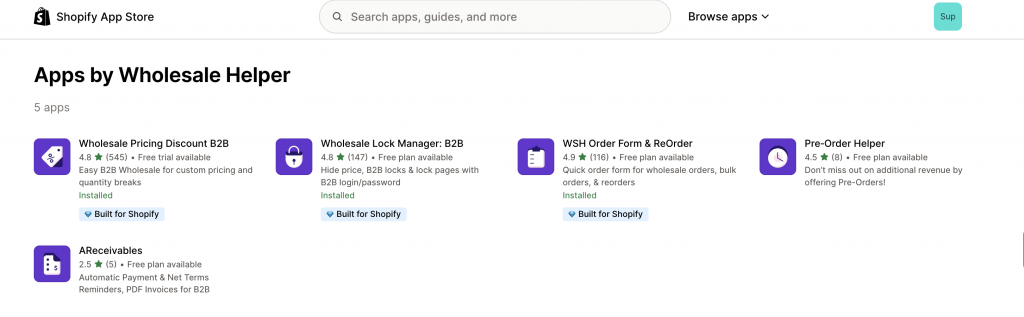
- Wholesale Pricing Discount B2B – Automates custom price lists, customer-tag-based discounts, volume discounts, net terms, and advanced shipping rules.
- Wholesale Lock Manager – Lets you hide wholesale prices or even entire products from retail customers, creating a “login to view price” experience for approved buyers.
- WSH Order Form & ReOrder – Speeds up bulk ordering by letting customers add multiple SKUs at once or quickly reorder previous purchases.
Product Data & Fitment Information
Auto parts buyers expect precise information; one wrong fitment can mean an expensive return.
- Use metafields or structured data to store OEM numbers, compatible makes/models/years, and notes about hazardous materials.
- Display core charges clearly on product pages, separate from the base wholesale price.
- Add disclaimers or links where needed, so resellers know their limits.
Step 5: Create Wholesale Policies
Clear, transparent policies are what separate a professional wholesale operation from a risky one. In auto parts, especially, policies aren’t just “fine print”; they protect your margins, reduce disputes, and give buyers confidence.
Core Return Policy
If you sell remanufactured parts, your core return policy is critical. Treat cores like the valuable assets they are.
- Dollar Amount: State the exact refundable core deposit per unit.
- Return Window: Give a clear timeframe (usually 30–90 days).
- Condition Requirements: Define what a “good” core looks like—complete, not heavily corroded or broken.
- Deductions: List reasons for partial or denied credits (e.g., missing pulley, cracked casing).
- Freight Responsibility: Spell out who pays for return freight and what documentation is required.
Warranty & RMA Policy
Warranty claims are inevitable in auto parts. A good warranty process prevents small issues from becoming disputes.
- Define Coverage: Be specific about what is covered (manufacturing defects) and what isn’t (improper installation).
- Credit vs Replacement: State whether you’ll issue credit, replacement, or both.
- Process: Require an RMA (Return Merchandise Authorization) number and clear documentation.
Freight & Prepaid Thresholds
Freight costs can quickly wipe out margins if not managed correctly.
- Prepaid Threshold: Set a clear minimum (e.g., “orders over $1,500 ship prepaid”).
- Accessorial Fees: Publish charges for liftgate, inside delivery, or residential delivery.
- Hazmat Handling: State that dangerous goods (DG) and oversized items follow special carrier requirements.
Restocking & Fitment Errors
Auto parts are prone to “wrong part” returns due to fitment errors.
- Customer Error: Charge a restocking fee (10–20%) plus return freight.
- Your Error: If your listing or cross-reference was wrong, waive fees and cover shipping.
MAP & Promotions
If you have a MAP policy, tie it into your wholesale terms.
- State that resellers must follow MAP when advertising.
- Allow only the promotions you’ve approved (e.g., sitewide coupons or “see price in cart”).
- Explain consequences for violations (warnings, suspension, or loss of rebates).
Step 6: Find and Onboard Customers
With your pricing, store, and policies in place, the next challenge is getting your first wholesale buyers. Auto parts wholesale is relationship-driven, so your approach should combine industry outreach with smart online tactics.
Target the Right Customer Types
- Retailers & Jobbers: Independent auto parts stores are always looking for reliable suppliers with competitive pricing.
- Repair Shops & Garages: These buyers prioritize consistent delivery and easy ordering systems.
- Fleets & Commercial Accounts: Companies that manage trucks, taxis, or service vehicles buy in bulk and value net terms.
- Performance & Specialty Shops: Smaller in volume but willing to pay for unique or niche products.
Where to Find Them
- Industry Directories: Many trade associations publish lists of retailers, distributors, and jobbers.
- LinkedIn Outreach: Connect with purchasing managers, fleet coordinators, and independent shop owners.
- Trade Shows & Expos: Events like AAPEX or regional auto trade fairs are prime networking opportunities.
- Online Forums & Groups: Mechanics and shop owners often gather in niche forums and Facebook groups—good places to spot potential wholesale leads.
- Marketplaces: List your products and auto parts businesses on well-known marketplaces.
Onboarding New Accounts
Once you’ve made contact, make onboarding easy:
- Wholesale Signup Form: Use your Shopify store (and a Wholesale Pricing Discount B2B app if needed) to create a secure “apply for wholesale” page.
- Account Approval Process: Review applications and assign customer tags for wholesale access.
- First-Order Incentives: Offer free freight on the first order or waive setup fees. Just make sure promos don’t conflict with your MAP policy.
- Clear Communication: Share your wholesale catalog, MAP sheet, and policies upfront so there are no surprises.
When native B2B is not enough, Wholesale Pricing Discount B2B is the next step.
Try our Wholesale Pricing Discount B2B app for free !
Trusted by over 16,000 Shopify merchants
Conclusion
Starting a wholesale auto parts business online is challenging—but with the right structure, it’s highly rewarding. Success comes down to three things:
- Strong Foundations: A clear business model, reliable supply chain, and accurate landed cost.
- Smart Pricing & Policies: Wholesale math that protects your margins, transparent core and warranty policies, and a MAP strategy to prevent race-to-the-bottom pricing.
- Scalable Systems: A Shopify store equipped with wholesale apps, customer portals, and automation to handle volume.
When you combine industry-specific pricing discipline with modern ecommerce tools, you can launch a wholesale auto parts business that not only survives but grows predictably year after year.
Frequently Asked Questions
How do I manage volatile freight costs for heavy parts?
Use a freight prepaid threshold (e.g., “$1,500 net”). Below that, bill actuals. For very heavy or oversized parts, consider shipping FOB (Free On Board), where the customer pays for the shipping directly and has more control over the carrier.
How should I handle a return for a “fitment error”?
Define a clear policy. If the customer ordered the wrong part, you can charge a restocking fee (e.g., 10-20%) plus the cost of return freight. If you made the error, you should waive the fee and cover the return shipping.
What’s a good way to handle promotions without violating MAP?
Offer fixed-price bundles (e.g., a brake pad set with a hardware kit) at an effective price that is at or above MAP. You can also offer post-purchase rebates or gift cards that don’t alter the advertised price.
What’s the difference between a warranty and a core return?
A warranty claim is a part that is believed to be defective and will result in a credit or replacement. A core return is a physical unit being returned for a refundable deposit and does not imply a defective part.
What product data should an auto parts wholesale store include?
At minimum, include SKU, brand, OE number, interchange number, year/make/model, engine or trim fitment, dimensions, weight, warranty, core charge, installation notes, restricted-state notes, hazmat flag, and supplier part number.

![How To Set Wholesale pricing for Health & Wellness Brand [2025]](https://wholesalehelper.io/blog/wp-content/uploads/2025/08/How-To-Set-Wholesale-pricing-for-Health-Wellness-Brand-2025--150x150.png)