
Key Takeaways
- Shopify is generally easier to launch and maintain because hosting, security, checkout, platform updates, and core B2B tools are managed in one system. WooCommerce offers more control over hosting, code, pricing logic, registration forms, user roles, and custom wholesale workflows.
- Shopify Basic, Grow, and Advanced plans support native company profiles, payment terms, volume pricing, vaulted cards, and up to three active B2B catalogues. WooCommerce does not include a complete wholesale system by default. Most stores need one or more wholesale extensions.
- WooCommerce can be cheaper for a simple setup, but hosting, premium plugins, development, security, and maintenance should be included in the total cost.
- Shopify is usually the better option for merchants who want a predictable and easier-to-manage setup. WooCommerce may suit businesses that already use WordPress and have technical resources available.
Shopify B2B and WooCommerce can both support wholesale selling, but they approach it very differently.
Shopify is a hosted ecommerce platform with native B2B features, a managed checkout, and an app ecosystem for additional wholesale workflows. WooCommerce is an open-source WordPress plugin that gives merchants more control, but wholesale functionality usually needs to be added through extensions or custom development.
The right option depends on how much flexibility you need, how comfortable your team is with technical maintenance, and whether you want your wholesale tools built into the platform or assembled separately. So let’s start this comparison guide on Shopify B2B vs WooCommerce Wholesale.
Shopify B2B vs WooCommerce Wholesale: Quick Comparison
| Area | Shopify B2B | WooCommerce Wholesale |
| Platform type | Fully hosted ecommerce platform | Open source plugin for WordPress |
| Wholesale features | Core B2B features are built into Shopify plans | Wholesale features usually require plugins |
| Customer management | Companies, company locations and buyer permissions | WordPress user roles and plugin-based customer groups |
| Wholesale pricing | Catalogues, fixed prices, percentage adjustments and volume pricing | Role-based, customer-based and quantity pricing through plugins |
| Product access | Managed through B2B catalogues, Markets, themes and apps | Managed through user roles, plugins or custom code |
| Registration | Company account request forms and company profiles | Custom registration and approval forms through plugins |
| Bulk ordering | Reorders and quick order lists are available, with apps for full order forms | Dedicated order forms and requisition lists available through plugins |
| Payment terms | Native payment terms and draft order workflows | Usually configured through plugins or payment gateways |
| Quotes | Usually requires an app or custom workflow | Available through some B2B extensions |
| Hosting and maintenance | Managed by Shopify | Managed by the merchant or hosting provider |
| Customization | Strong app and API ecosystem, with platform boundaries | Full access to code, hosting and database |
| Best suited for | Merchants wanting a managed and predictable system | Businesses wanting deeper technical control |
What Is Shopify B2B?
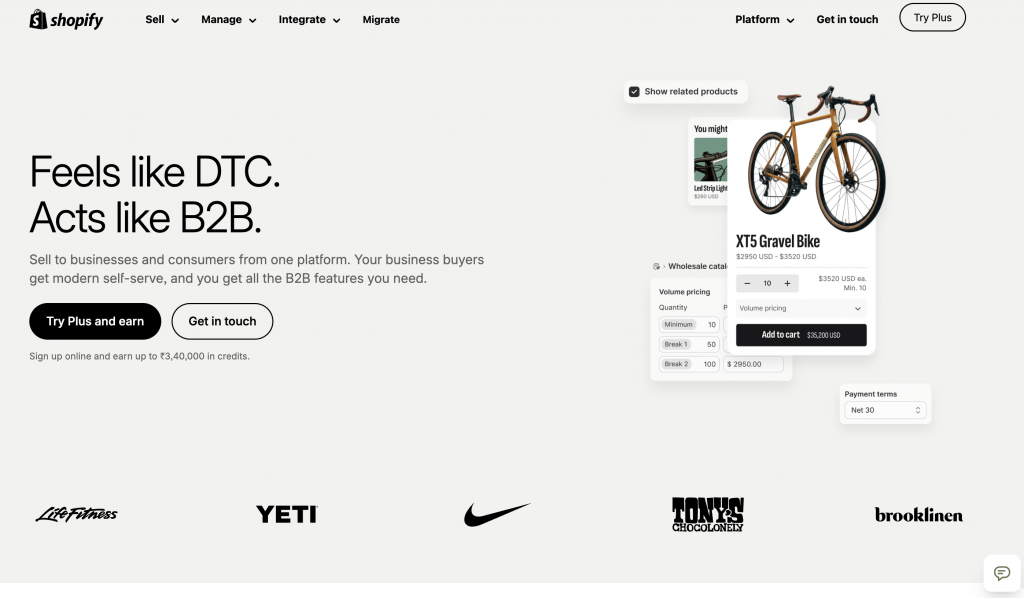
Shopify B2B is Shopify’s native system for selling to business buyers.
Merchants can create companies and company locations, assign B2B customers, control product availability, offer wholesale prices, set payment terms, collect purchase order numbers, and allow buyers to reorder through their customer accounts.
Shopify can support a dedicated wholesale store or a blended store that serves retail and wholesale customers from the same backend.
Basic, Grow, and Advanced stores can assign up to three active B2B catalogues across their B2B markets. Shopify Plus supports unlimited catalogues and lets merchants assign catalogues directly to individual companies and company locations.
Shopify Plus also retains certain advanced features, including customer-specific deposits and partial payments.
What Is WooCommerce Wholesale?
WooCommerce is an e-commerce plugin for WordPress. The core WooCommerce plugin supports products, orders, checkout, inventory, payments, taxes, and shipping, but it does not provide a complete wholesale system by default. Merchants normally add wholesale capabilities through extensions.
Depending on the extension, a WooCommerce wholesale store may support:
- Different prices for different user roles
- Tiered and quantity-based pricing
- Wholesale registration forms
- Manual customer approval
- Hidden prices and products
- Quote requests
- Minimum order requirements
- Private wholesale areas
- Role-specific shipping and payment methods
- Bulk order forms
- Tax exemption workflows
This gives merchants considerable flexibility. It also means the quality and reliability of the wholesale setup depend on the plugins, theme, hosting provider, and custom code being used.
There is no single standard version of “WooCommerce Wholesale.” Two WooCommerce stores can use completely different plugins and workflows while both being described as wholesale stores.
Which is better? Shopify B2B vs WooCommerce Wholesale
1. Setup and Ease of Management
Shopify is usually easier to set up, especially for merchants who do not have an internal developer.
Hosting, SSL, checkout, platform updates, payment integrations, security infrastructure, and the main e-commerce admin are included in the platform. Native B2B tools also sit inside the same Shopify admin used for products, customers, orders, discounts, and analytics.
WooCommerce requires more separate decisions.
You need a WordPress website, hosting, a compatible theme, WooCommerce, payment integrations, and one or more wholesale plugins. You may also need tools for backups, security, caching, email delivery, spam prevention, and performance monitoring.
This is not necessarily a disadvantage for experienced WordPress teams. It gives them control over every part of the store. For merchants without technical support, however, it can create more work and more opportunities for plugin conflicts.
Winner for ease of management: Shopify
2. Wholesale Pricing and Product Catalogues
Shopify B2B uses catalogues to control the products and prices available to business buyers. Merchants can set custom product prices, percentage-based adjustments, quantity rules, and volume price breaks.
For stores with a few broad customer groups, this can cover the main requirements without another wholesale pricing tool.
The limitation becomes more noticeable when a business has many buyer groups, negotiated customer prices, or separate pricing structures for different locations.
Basic, Grow, and Advanced plans share a limit of three active B2B catalogues across all B2B markets. Directly assigning a catalogue to a particular company or company location requires Shopify Plus.
WooCommerce pricing is normally controlled through user roles and plugin rules. Depending on the extension, merchants may be able to set:
- A fixed price for each wholesale role
- Percentage discounts by category
- Customer level prices
- Different prices for product variations
- Cart total discounts
- Quantity-based price breaks
- Minimum and maximum order quantities
WooCommerce may provide more pricing flexibility, but only when the selected plugin supports the required rules. Merchants should check compatibility before building their pricing structure around a particular extension.
Winner for structured native pricing: Shopify
Winner for highly customized pricing logic: WooCommerce
3. Wholesale Customer Management
Shopify has a clear B2B customer structure built around companies and company locations.
A company can have multiple locations, buyers, shipping addresses, payment terms, tax settings, catalogues, and contact permissions. This is useful when one business customer operates several branches or allows multiple employees to place orders.
WooCommerce normally manages wholesale customers through WordPress user roles. A plugin may create roles such as wholesaler, distributor, dealer, gold customer, or trade buyer.
This system is flexible and familiar to WordPress developers. However, it does not provide the same standardized company and location structure unless a plugin or custom build adds it.
For straightforward customer tiers, WooCommerce roles can work well. For businesses that need several buyers and locations under one company account, Shopify’s native model is generally easier to manage.
Winner for company account management: Shopify
4. Registration and Customer Approval
Shopify supports company account request forms that let potential buyers apply for B2B access. Merchants can collect business information before creating or approving a company account.
Shopify wholesale apps can add more control when a business needs longer forms, document uploads, custom approval rules, customer tagging, or different application flows.
WooCommerce wholesale extensions often include detailed registration forms and manual approval. Merchants can add business fields, assign approved customers to user roles, request tax information, or collect supporting documents.
WooCommerce can be more flexible here, especially when the business has an unusual application process. The trade-off is that the entire workflow depends on the selected plugin.
Winner for flexible registration forms: WooCommerce
Winner for a simpler native company setup: Shopify
5. Bulk Ordering and Reordering
Wholesale customers often know exactly what they want to buy. Opening individual product pages for every SKU can make a large order unnecessarily slow.
Shopify B2B customers can view their order history and duplicate previous orders through customer accounts. Shopify also supports quick order lists that let buyers add multiple variants of a product from its product page.
A full catalogue order form, where buyers can search and add several different products from one page, will normally require an app.
For example, the WSH Order Form & ReOrder app can add a single-page ordering experience for buyers who regularly purchase multiple products or repeat previous orders on your Shopify wholesale store.
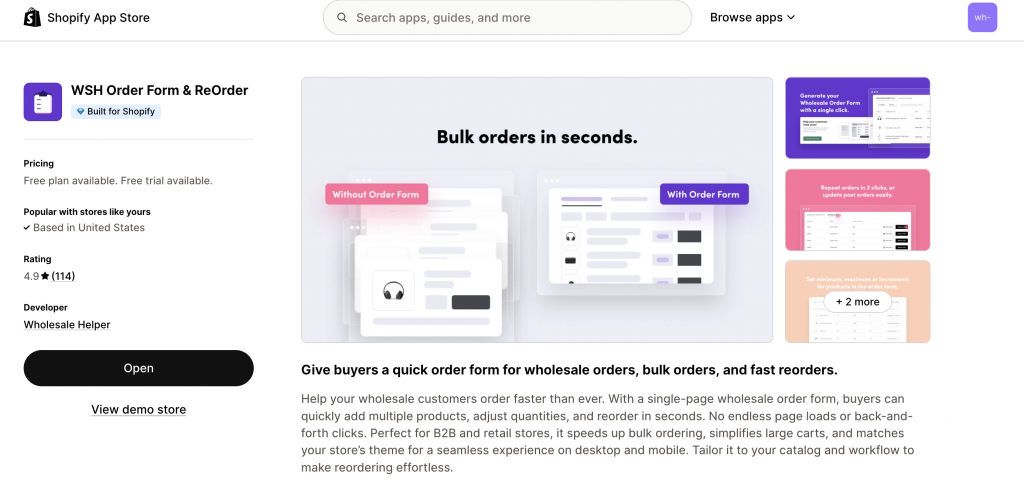
WooCommerce can also support bulk order forms, requisition lists, saved lists, and repeat orders through wholesale plugins. The exact buyer experience will depend on the extension and theme.
Both platforms can provide a good wholesale ordering flow. Shopify offers a more standardized account and checkout experience, while WooCommerce gives developers more freedom to change how the order form works.
6. Payment Terms, Purchase Orders and Quotes
Shopify B2B supports payment terms at the company location level. Merchants can also collect purchase order numbers, create draft orders, send invoices, and require certain orders to be submitted as drafts for review.
Customer-specific deposits and partial B2B payments remain Shopify Plus features.
A formal request-a-quote system is not a standard part of the core Shopify B2B experience. Merchants that negotiate prices before confirming orders may need an app or custom workflow.
WooCommerce can offer invoice payments, delayed payment methods, quotes, payment restrictions, and role-specific gateways through extensions.
This can make WooCommerce attractive for businesses with unusual payment or quote processes. However, these features may come from different plugin developers and may not always work as one connected system.
Winner for built-in payment terms and purchase order workflows: Shopify
Winner for custom quote workflows: WooCommerce
7. Store Customization and Technical Control
WooCommerce gives merchants full access to their WordPress files, database, hosting environment, themes, templates, and plugin code.
A development team can build a highly specific wholesale experience without being limited by a hosted platform. WooCommerce can also connect with a wide range of payment providers, ERP systems, warehouse tools, and custom databases.
The downside is that every customization becomes something the business must maintain.
Shopify places more boundaries around the platform, particularly around checkout and backend infrastructure. However, it provides themes, apps, APIs, Shopify Functions, customer account extensions, and other tools for customizing B2B workflows.
For most merchants, Shopify offers enough flexibility without requiring them to maintain the core platform. Businesses with highly unusual requirements may still prefer the control WooCommerce provides.
Winner for complete technical control: WooCommerce
Winner for customization with less maintenance: Shopify
8. Security, Updates and Store Performance
Shopify manages the e-commerce hosting environment and provides PCI-compliant infrastructure for its stores. Platform updates are handled centrally, so merchants do not need to update Shopify itself or manage a server.
Apps and themes still need to be selected carefully, but the main infrastructure is managed by Shopify.
With WooCommerce, the merchant and hosting provider are responsible for keeping WordPress, WooCommerce, PHP, themes, and plugins updated. Regular backups and testing are important because an update to one extension can sometimes affect another part of the store.
WooCommerce can support large and complex businesses when it has strong hosting and experienced technical management. Poor hosting or an overloaded plugin stack can create performance and reliability problems.
Winner for lower technical maintenance: Shopify
9. Shopify B2B vs WooCommerce Wholesale Cost
Shopify has a clear monthly platform subscription. Additional costs may include themes, apps, payment processing, custom development, or a Shopify Plus subscription for more advanced requirements.
The cost is usually easier to predict because hosting and the main ecommerce infrastructure are included.
WooCommerce itself is free and open source, but a functioning wholesale store may still need:
- Web hosting
- A domain
- Premium wholesale plugins
- A paid theme
- Backup and security tools
- Performance optimization
- Developer support
- Ongoing maintenance
A simple WooCommerce store can cost less than Shopify. A heavily customized wholesale store may become more expensive once development and maintenance are included.
The better comparison is total cost of ownership, not just the platform fee.
Can Shopify Apps Close the Flexibility Gap?
Shopify’s native B2B features now cover many standard wholesale requirements. Apps remain useful when a merchant needs workflows that do not fit neatly inside the native company and catalogue structure. Shopify B2B apps like Wholesale Pricing Discount B2B, Sparklayer, BSS B2B Solution, and Wholesale Gorilla significantly help elevate your storefront experience and also close this flexibility gap for your wholesale customers.
Which Platform Should You Choose?
Choose Shopify B2B when:
- You want hosting, checkout, security, and platform updates managed for you.
- Your team does not want to maintain WordPress and multiple plugins.
- You need company profiles, company locations, payment terms, catalogues, purchase order numbers, and reordering in one system.
- You sell both retail and wholesale from the same store.
- You want predictable platform behaviour and a large app ecosystem.
- You are comfortable using apps when native features do not cover a workflow.
Choose WooCommerce Wholesale when:
- You already operate a successful WordPress or WooCommerce store.
- You have reliable WordPress developers or an agency.
- You need complete control over hosting, code, database access, and checkout logic.
- Your wholesale workflow requires detailed user roles, custom forms, unusual pricing rules, or quote processes.
- You are prepared to manage updates, compatibility, performance, backups, and security.
- Migrating away from your existing WooCommerce setup would create more work than improving it.
Final Summary
Shopify B2B is the better choice for most merchants who want to launch or grow wholesale without taking on additional technical maintenance.
Its native B2B features now cover company accounts, catalogues, volume pricing, quantity rules, payment terms, purchase order numbers, and reordering across Shopify’s paid plans. Apps can fill gaps such as advanced pricing, private product access, and full catalogue order forms.
WooCommerce Wholesale remains a strong option for businesses that already use WordPress or need complete technical control. It can support highly customized wholesale operations, but the business must take greater responsibility for hosting, plugins, updates, security, and development.
Do not migrate an established WooCommerce store only because Shopify appears easier. Likewise, do not choose WooCommerce only because its core plugin is free. Compare the complete wholesale workflow, the technical resources available to your team, and the long-term cost of maintaining the store.
Frequently Asked Questions
Is Shopify B2B available only on Shopify Plus?
No. Since April 2026, Shopify Basic, Grow, and Advanced plans have access to core native B2B features. These include company profiles, payment terms, volume pricing, vaulted credit cards, and up to three active B2B catalogues. Shopify Plus still provides higher limits and additional features.
Does WooCommerce include wholesale pricing by default?
No. Core WooCommerce supports standard retail product prices. Wholesale prices, customer roles, private catalogues, registration approval, quotes, and bulk ordering normally require extensions or custom development.
Is WooCommerce cheaper than Shopify for wholesale?
It can be, particularly for a small store with a simple plugin setup. However, the comparison should include hosting, premium extensions, development, backups, security, maintenance, and performance optimization.
Can Shopify and WooCommerce support retail and wholesale customers in one store?
Yes. Shopify can operate a blended B2B and D2C store using companies, B2B markets, catalogues, customer accounts, and apps. WooCommerce can show different prices, products, and payment methods based on user roles when the appropriate extensions are installed.
Is Shopify or WooCommerce better for a large wholesale business?
Store size alone should not decide the platform. Shopify may suit large businesses that want managed infrastructure and standardized B2B operations. WooCommerce may suit businesses with experienced technical teams and highly customized requirements.