
Key takeaways
- Shopify B2B can now be started on any paid plan using native features, but non-Plus merchants are capped at 3 active B2B catalogues. For stores with 4 or more buyer tiers, registration workflows, a bulk order form, or POS wholesale, third-party apps fill what native B2B does not cover.
- Typical B2B requirements include customer-specific pricing, bulk ordering, restricted catalogs, and B2B-friendly checkout options.
- If you don’t use Plus, you can still create a B2B experience by combining a pricing/discount app, access control, and a bulk order form.
Shopify now offers native B2B features across all paid plans, not just Plus. As of April 2026, merchants on Basic, Grow, and Advanced can access B2B catalogues, company profiles, and volume pricing directly from their Shopify admin.
This guide covers what Shopify’s native B2B can do, where it stops, and how to decide which setup works for your store.
What is a Shopify B2B store?
A Shopify B2B store is an e-commerce website built on the Shopify platform, specifically customized to provide B2B pricing and discounts for a select group of customers, such as wholesalers and retailers.
The big difference vs B2C is expectations: B2B buyers reorder frequently, purchase in larger quantities, and expect negotiated pricing and smoother purchasing (fewer emails, fewer manual quotes). That usually translates into:
- B2B checkout needs (net terms, POs, tax/VAT handling, etc.)
- Customer-specific pricing (price lists, tiered pricing, volume discounts)
- Bulk ordering (quick add, order forms, CSV/variant grids)
- Restricted access (lock collections/products/pages until approved)
Is Shopify good for B2B?
Yes, Shopify is a great platform for building B2B stores. Since April 2026, all paid Shopify plans include native B2B tools: company profiles, B2B catalogues with custom pricing, volume discounts, and a buyer self-serve portal. If you have a simple wholesale setup with two or three buyer tiers, that might be enough.
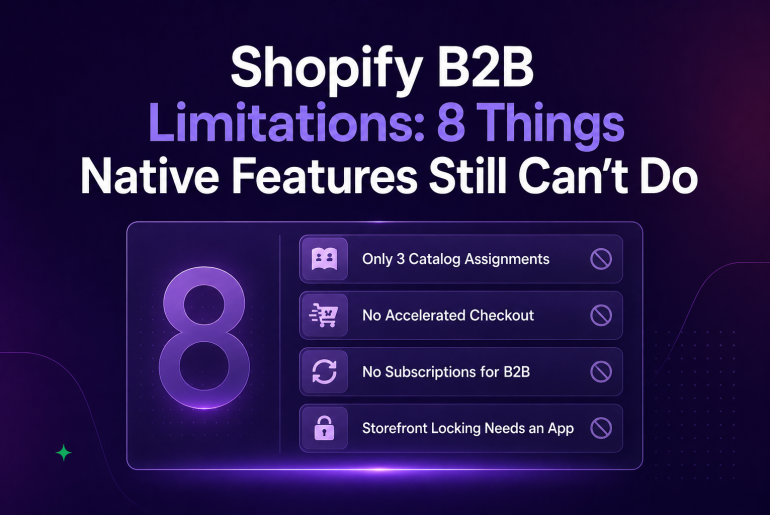
But non-Plus plans have hard limits. You get 3 active B2B catalogs maximum. No wholesale registration form — buyers have to be added manually. No bulk order form. No customer-tag-based pricing. And B2B catalogs do not work in Shopify POS.
If your store grows past those limits, apps like Wholesale Pricing Discount B2B cover the gaps without requiring a Plus upgrade.re.
How much does a Shopify B2B store cost?
You can create the Shopify B2B experience for your customers either by selecting the Shopify Plus plan or by using a third-party app like Wholesale Pricing Discount B2B from the app store.
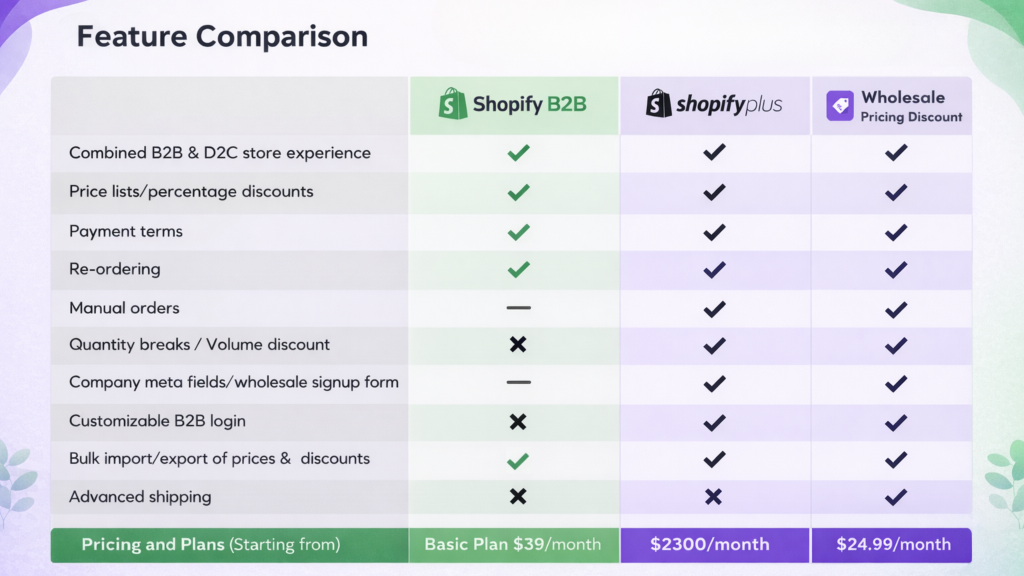
Below is a cost breakdown for three approaches: Shopify Plus, third-party B2B apps, and custom development via an agency.
(a) Using Shopify’s native B2B (all paid plans)
Since April 2026, Shopify has included native B2B features on all paid plans at no extra cost. Company profiles, up to 3 active B2B catalogues, custom pricing, and volume discounts are built in.
For a store just starting wholesale with a small number of buyer tiers, this is a reasonable place to begin. There is no additional monthly cost beyond your existing Shopify plan, which starts at $39/month for Basic.
The limits kick in quickly, though. Three catalogs are a hard cap on non-Plus plans. There is no registration form, no bulk order form, and no tag-based pricing. Stores that grow past those constraints either upgrade to Shopify Plus at $2,300/month or fill the gaps with apps.
Read more: Shopify B2B Limitations: 8 Things Native Features Still Can’t Do
(b) Using Shopify Plus – B2B eCommerce platform
Shopify Plus started offering its B2B features in June 2022. It allowed D2C stores running on the Shopify platform to run a wholesale and retail store from a single Shopify store (without requiring any third-party customization). However, upgrading to Shopify Plus may seem costly for store owners that just started their business or are making initial profits from their sales.
Shopify Plus typically starts around $2,300/month. This path is best when you need native B2B tooling, centralized control, and enterprise workflows—otherwise, third-party apps may be more cost-effective.
(c) Using a third-party Shopify B2B app stack
If upgrading to Shopify Plus is too much for you, then consider using third-party Shopify B2B apps to create a wholesale experience for your B2B customers. The Shopify App Store has multiple third-party apps with wholesale features that cater to B2B stores, including page builders, inventory management apps, marketplace integrations, and more.
And the prices vary depending on the features you choose, but generally, these apps start at around $25/month
Additionally, your Shopify subscription cost may apply (e.g., $39/month for Basic, $105/month for Shopify, or $399/month for Advanced plans).
(d) Building a customized B2B store from scratch by hiring a developer or a Shopify agency
If you need more advanced features, such as a custom product search or customer account management, you may want to consider hiring a developer or a Shopify agency/Service partner to customize your Shopify B2B store for you.
The cost of Shopify development services is based on the project’s complexity and the service provider’s experience. While this option may be more costly and take longer, it allows you to design personalized features that meet your specific B2B store requirements.
Shopify B2B store examples
These examples show common B2B implementation patterns on Shopify, such as password-protected wholesale areas, wholesale registration, and bulk ordering pages. Each example highlights the B2B access model and the ordering workflow used.
1. The Gluten Free Bar
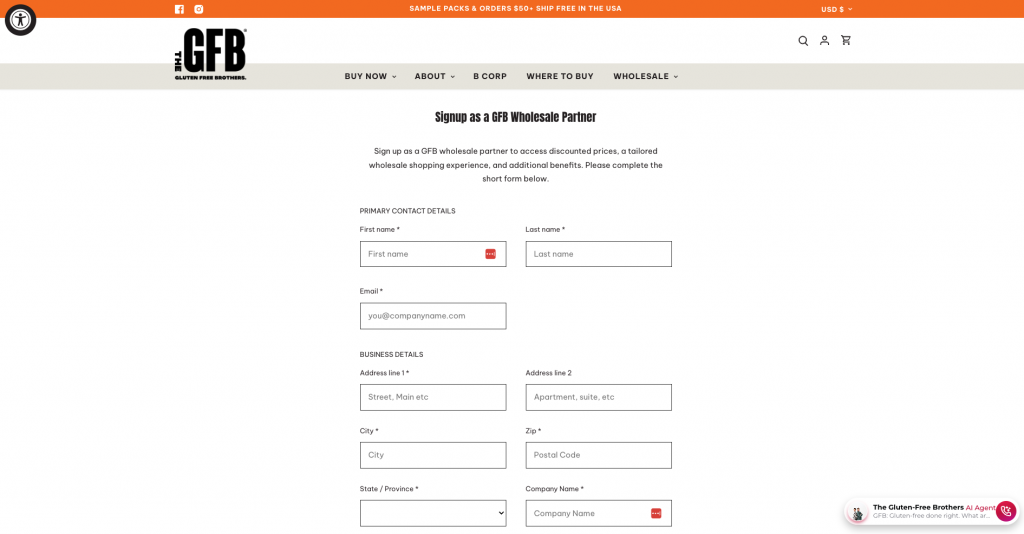
The Gluten Free Bar sells gluten-free snack bars and pantry-friendly treats, and uses a simple wholesale setup that lets approved B2B customers access trade pricing while keeping the retail store experience unchanged for regular shoppers. Once a customer is assigned to a wholesale group, the store automatically shows the correct wholesale prices and discounts—without needing a separate wholesale site.
2. K9 Sport Sack
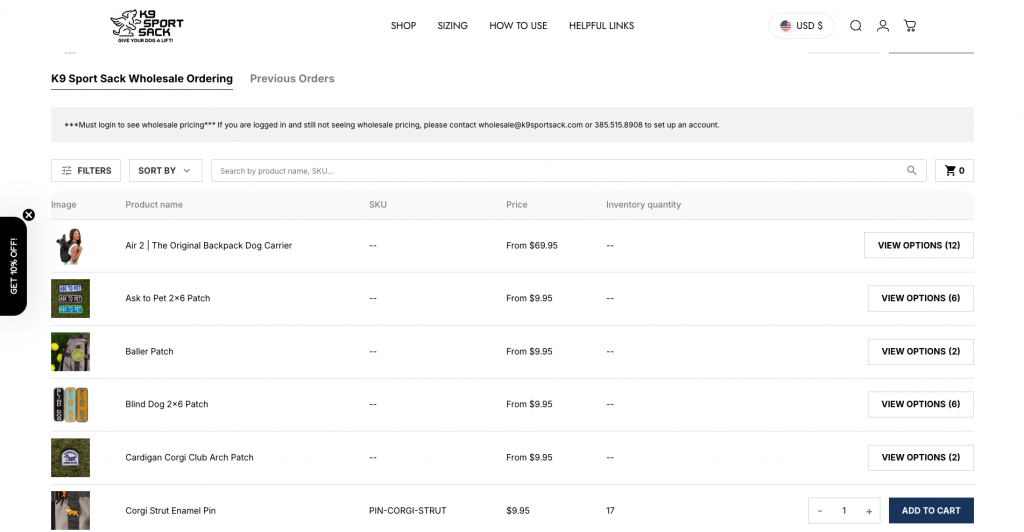
K9 Sport Sack sells forward-facing backpack dog carriers and related pet accessories, and they make wholesale ordering easy with a dedicated Wholesale Order Form page. Approved retail partners can log in to see wholesale-only pricing and quickly place bulk orders from one streamlined catalog (with options like viewing/repeating previous orders), instead of adding items one-by-one through the regular storefront.
3. Barneys Salon Supplies
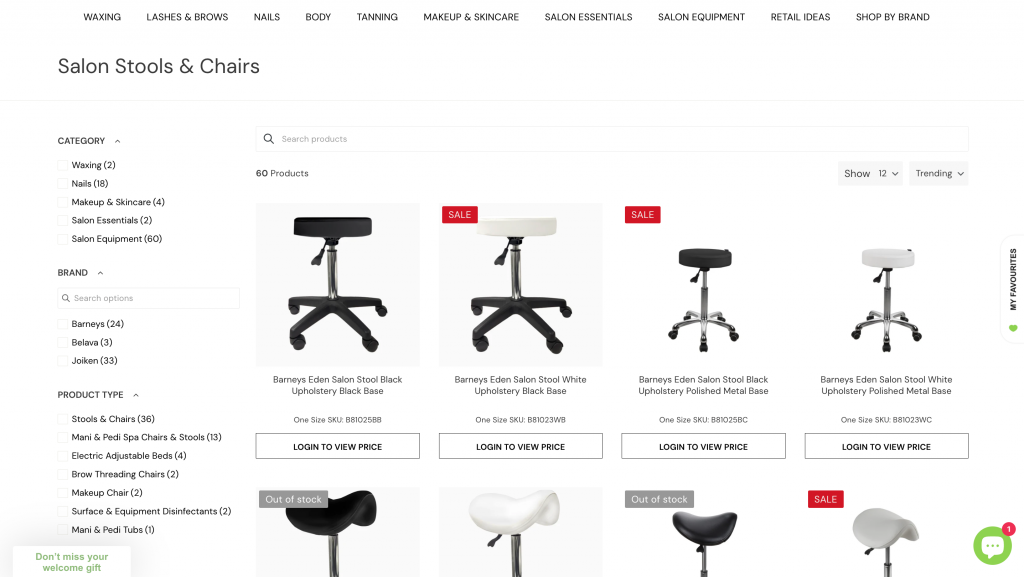
Barneys Salon Supplies is an Australian business that sells professional salon stools and chairs for beauty and treatment spaces, and they keep trade pricing gated behind a “Login to view price” prompt across the collection—so only approved customers can see wholesale pricing while the public catalog stays visible for browsing.
4. Born and Raised
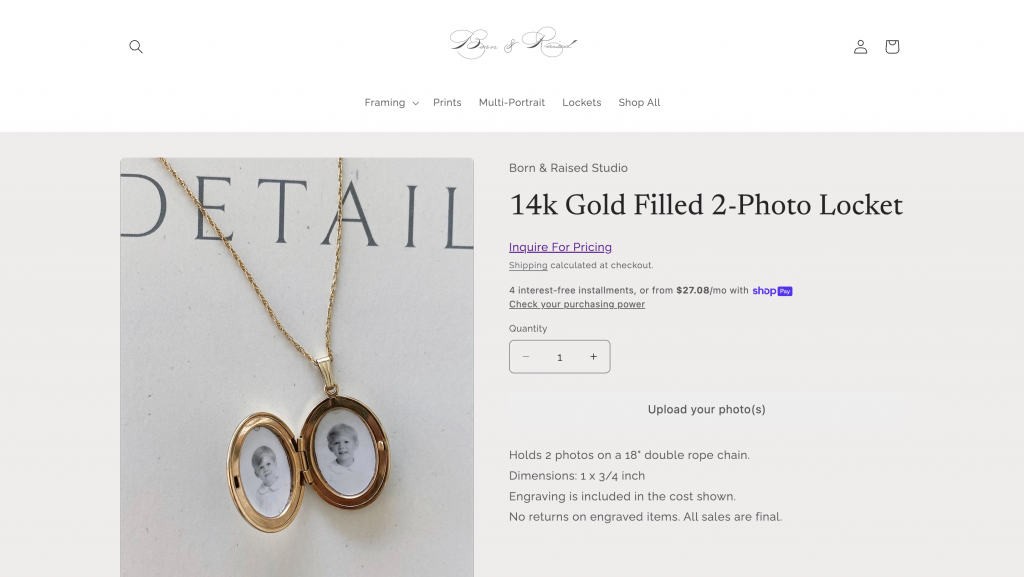
Born & Raised Studio sells jewelry pieces like this 14k gold-filled oval locket, and instead of letting shoppers add it to the cart, the product page shows an “Inquire for Pricing” button. That’s a lock-style setup: when someone clicks it, they’re redirected to a specific inquiry form URL—similar to “login to view price” flows that send customers to a login page before pricing is shown.
5. The Nut Garden
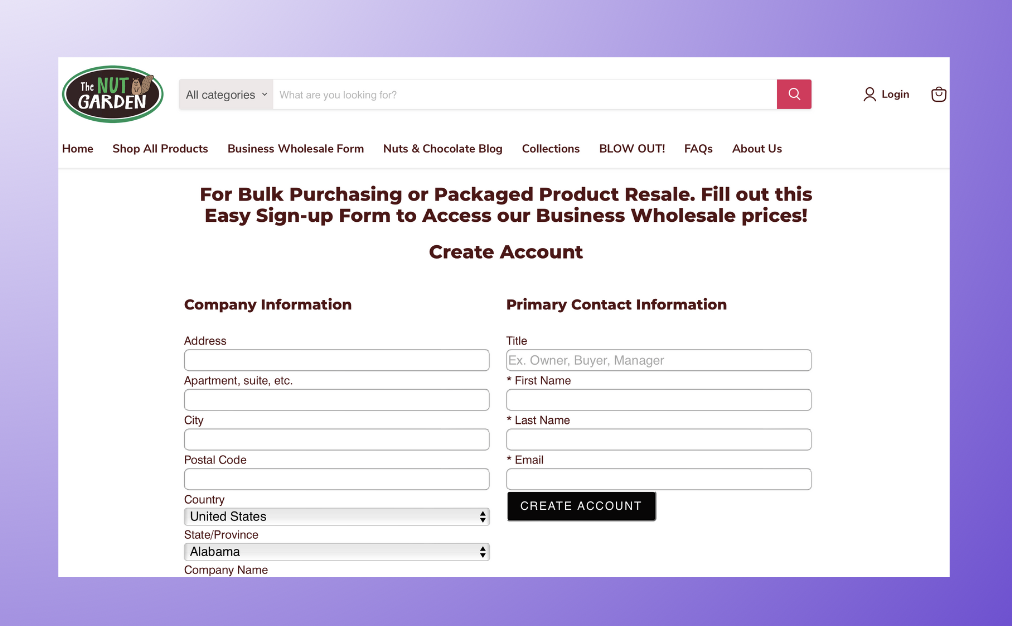
The Nut Garden specializes in a wide variety of nuts, candies, and gourmet gifts, appealing to both retail and wholesale customers. Their platform facilitates bulk purchasing and resale opportunities, providing an easy wholesale signup for business wholesale access.
How to create a Shopify B2B store without a Plus plan (8 easy steps)
STEP 1: Choose the right Shopify plan
Pick a plan based on catalog size, staff needs, and reporting needs. You can start small and upgrade later — what matters most is ensuring your plan supports the storefront experience you want for both retail and B2B.
There are three main plans available: Basic Shopify, Shopify, and Advanced Shopify, each with distinct features and pricing. The Basic Shopify plan is recommended for small businesses, while the Shopify and Advanced Shopify plans are suitable for medium and large businesses. Pick a plan that is appropriate for your needs and budget.
STEP 2: Create a professional store design
The next step is to create a professional store design. B2B buyers still judge trust quickly. Clean navigation, clear categories, and fast search matter. If your catalog is large, prioritize filters and collection structure before you worry about fancy design.
Shopify offers a wide range of free and paid themes that you can use to design your store. You can also hire a Shopify expert to design a custom theme for your store.
STEP 3: Create Companies, Catalog and Set Discounts
Once you select a plan and choose a theme/customize your store’s basic frontend, the next step is the actual B2B structure: Companies, catalogues,gues and discounts
In your Shopify admin, go to Customers > Companies to create a company profile for each B2B buyer – this could be a retailer, wholesale account, or distributor. You can select multiple company locations for each company and assign a specific catalog, pricing and payment terms for each location. This is how you keep your B2B buyers separate from regular retail customers, with their own login and own (discounted pricing) view of your store.
Next, build a Catalog; each catalog can be assigned to a specific company, with pricing/discounts that can differ from your retail storefront prices. As we discussed earlier, if you’re on the Basic, Grow, or Advanced plan, you can only create up to 3 active catalogs across all B2B markets; Shopify Plus removes this limit entirely.
Next, set Discounts/Pricing; you can set fixed custom pricing per product or use quantity rules and volume dicsounts within each catalog. This is to reward B2B buyers for placing large orders. For example, a lower per-unit price once a buyer orders 50+ units. This is where most of your actual wholesale margin logic lives, so it’s worth setting up carefully before inviting buyers in.
Native Shopify volume discounts are fairly basic (simple quantity breakpoints). If you want tiered customer-group pricing, mix-and-match bulk discounts, or more flexible rules, that’s exactly the gap apps like Wholesale Pricing Discount B2B fill.
Optional: Install the right apps
In the Shopify ecosystem, most non-Plus merchants use this Shopify B2B app stack to scale their business running on Shopify’s built-in B2B features:
- Wholesale Pricing Discount B2B: A wholesale app that allows you to create custom pricing and discounts for your B2B customers and helps you run a fully-fledged wholesale store.
- Wholesale Lock Manager: An app that allows you to restrict access to certain products or pages on your store.
- WSH Order Form & ReOrder: An app that allows B2B customers to order in multiple and bulk quantities on a single-page order form.
Read Also:
Shopify Native B2B vs Third-Party Apps: How to Choose the Right Wholesale Setup
Shopify Plus vs Third-Party Apps: What’s Best for Wholesale in 2026
STEP 4: Create a custom pricing strategy that your buyers understand
A custom pricing strategy is essential for a successful Shopify B2B store. B2B customers usually buy in bulk and expect discounts. You can set the custom pricing for your B2B customers using the Wholesale Pricing Discount app. You can also set individual product variant pricing, offer volume discounts or tiered pricing based on the order quantity using the same app.
B2B pricing should be predictable. Common models:
- % off MSRP by customer group
- Tiered pricing (price breaks by quantity)
- Volume discounts by quantity thresholds
- Customer-specific negotiated price lists
Whatever you choose, make it easy to answer: “What price do I get, at what quantity, and why?”
STEP 5: Optimize your product pages
Optimizing your product pages is crucial for a successful B2B store. Your product pages should be informative and detailed, with clear images and descriptions.
Your B2B product pages should clearly show:
- MOQ / case pack rules (if any)
- Lead times
- Variant ordering (sizes, packs, colors)
- Shipping expectations
- How pricing changes by tier or customer group
STEP 6: Streamline your checkout process
To run a successful B2B store, it’s important to have a checkout process that’s quick and easy to navigate. Use Shopify checkout for standard card payments.
If you offer B2B payment workflows such as invoicing or payment terms, ensure your setup supports those options alongside checkout. Alternatively, you can also opt for a third-party app like Shop Pay to simplify the process. Additionally, it’s a good idea to offer various payment options such as credit cards and invoicing.
STEP 7: Make reordering fast
This is where B2B wins:
- Saved carts/draft orders (depending on setup)
- Reorder from past orders
- One-page order form
- Quick add by SKU/variant
STEP 8: Customer service that works for B2B
Provide buyers with satisfactory customer service for ordering, invoices, and delivery inquiries if they encounter any issues while placing orders on your Shopify B2B store.
Here’s a simple B2B support setup that scales:
- A clear wholesale FAQ page (MOQ, lead time, shipping, returns)
- A dedicated wholesale inbox
- An order issue form that asks for PO/order # up front
- A “reorder help” doc (how to reorder, how pricing works, how approvals work)
You can manage customer inquiries and support using either Shopify’s customer service tools or a third-party app.
Benefits of creating a Shopify B2B store
A Shopify B2B store offers several advantages over a standard B2C store when it comes to selling your products to specific customers. Here are some of the benefits:
- Display discounts and wholesale pricing: Wholesale pricing and discounts are difficult to manage with a standard B2C store, but they can easily be managed in a Shopify B2B store.
- Streamline processes: B2B stores often have complex order management processes that must be tracked and monitored, such as custom invoicing, payment terms, and shipping schedules. A Shopify B2B store makes it easier to streamline these processes by automating them with apps.
- Higher average order values: B2B stores typically have higher average order values than B2C stores, making them more profitable.
- More targeted marketing: With segmented customer accounts, you can send custom campaigns to different types of businesses and tailor your messaging accordingly.
- Improved customer service: Features like account management and bulk discounts make it easier for customers to do business with you.
Conclusion
To build a successful B2B store on Shopify, you need to plan and execute carefully. This article provides helpful tips that can guide you in creating a custom and professional-looking B2B store. By focusing on your customers’ needs and following the right plan, design, pricing strategy, product pages, checkout process, apps, and customer service, you can grow your Shopify B2B business successfully.
To get additional help with creating a thriving Shopify B2B store, visit the Shopify app store and explore the top Shopify B2B apps. By using the appropriate apps, you can simplify store management and enhance its potential for expansion.
Happy wholesaling!
When native B2B is not enough, Wholesale Pricing Discount is the next step.
Try our Wholesale Pricing Discount app for free !
Trusted by over 15,000 Shopify merchants
FAQs
Is Shopify B2B or B2C?
Shopify is both B2B (business-to-business) and B2C (business-to-consumer). It provides tools and features that allow merchants to sell to both types of customers. With Shopify Plus or a third-party app like Wholesale Pricing Discount B2B, you can run B2B and B2C from a single store.
What are the costs involved in setting up a Shopify B2B store?
The costs can vary based on your approach. If you are just starting, Shopify’s native B2B features might just do the job. Upgrading to Shopify Plus starts at $2,300/month. Alternatively, using third-party Shopify B2B apps might be more affordable, with prices starting around $30/month.
What are some common use cases for Shopify B2B stores?
Common use cases include wholesale stores, bulk office supplies, and advertising deals platforms, where businesses sell products or services in bulk to other businesses at discounted rates.
Do I need Shopify Plus for my B2B operations?
While Shopify Plus offers advanced B2B features, it’s not strictly necessary. You can also use Shopify Native B2B features or third-party B2B apps available in the Shopify app store to create a wholesale experience without Shopify Plus.
How can I create a Shopify B2B store without using Shopify Plus?
Start by choosing the right Shopify plan for your business size, then enhance your store with a professional design and install third-party apps like Wholesale Pricing Discount to offer custom pricing and discounts
What features should I look for in apps for my Shopify B2B store?
Look for apps that allow custom pricing strategies, bulk ordering capabilities, and access restrictions for B2B customers. Apps that streamline the ordering process, like WSH Order Form & ReOrder, are also beneficial.
Why is custom pricing important in Shopify B2B stores?
Custom pricing is crucial because B2B customers often place large orders and expect discounts. Tailoring prices for these customers can encourage larger orders and foster long-term business relationships.